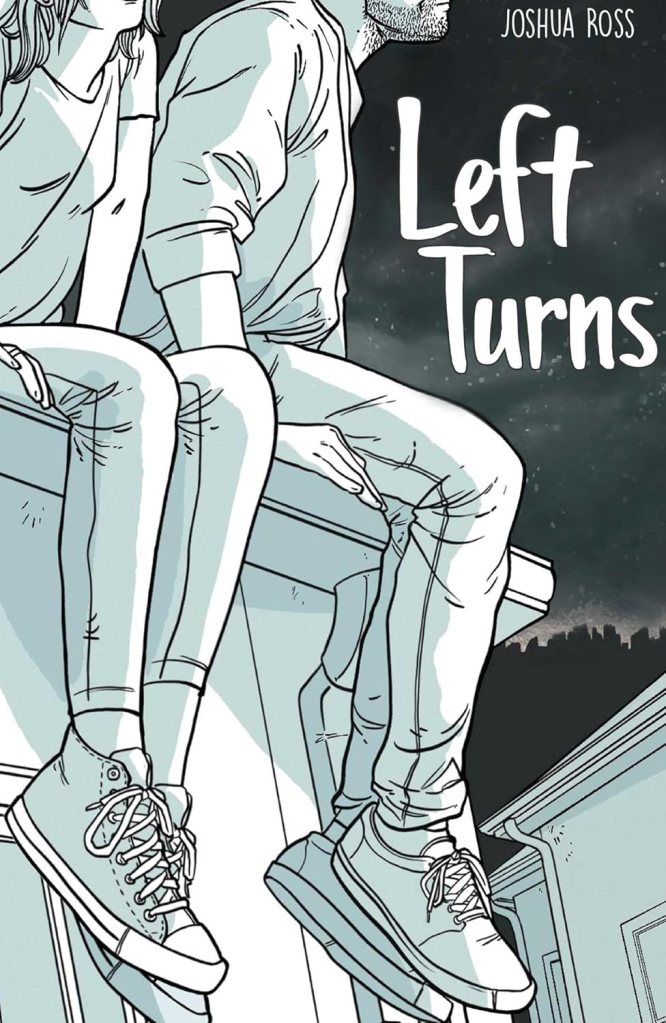
An Honest and Visually Expressive Coming-of-Age Story for Dreamers on the Edge of Adulthood
⭐️⭐️⭐️⭐️
Left Turns by Joshua Ross is a thoughtful and visually experimental graphic novel about ambition, identity, and the painful (but often necessary) detours life throws our way. Told through a mix of narrative captions, expressive sketches, and handwritten inner monologues, the story follows David, a 25-year-old aspiring comic book artist navigating adulthood in the early 2000s. David believes his life is finally clicking into place—but a series of unexpected “left turns” forces him to question just how far he’s willing to go for his art, and what he’s willing to give up in the process.
Set in a loosely sketched but emotionally vivid urban environment, the story blends semi-autobiographical realism with surreal flourishes that reflect David’s inner chaos. He’s got a decent job, a girlfriend who supports him, and a dream that feels—at least at first—within reach. But over the course of the novel, that illusion begins to crack. Artistic frustration, self-doubt, relationship tension, and a slowly unraveling sense of purpose push David to confront whether the life he’s chasing is the one he really wants—or just the one he thought he was supposed to want.
One of the book’s strengths is its emotional honesty. David isn’t romanticized. He’s self-critical, neurotic, and often stuck in his own head. In one particularly revealing moment, he thinks, “I tell people I’m an artist, but the truth is I haven’t finished anything in over a year.” That kind of brutal self-awareness shows up frequently, giving readers a raw view of the internal battles that come with being a creator in your twenties—especially when the world isn’t waiting to hand you a break.
Visually, the book leans into a rough, unpolished aesthetic that matches David’s emotional state. Panels range from structured to chaotic, sometimes reflecting real events and sometimes diving into metaphor. There are sequences where his anxiety takes physical form, looming over him like a shadow, and others where memories bleed into the present. These choices give the book a personal, almost diary-like feel. The imperfections in the linework and lettering don’t detract—they’re part of the point.
The themes here are universal for any creative person trying to “make it”: fear of mediocrity, imposter syndrome, financial pressure, and the ever-present tension between art and stability. At one point, David reflects, “I thought talent would be enough. But talent doesn’t pay rent.” That line sums up the novel’s underlying tension—how to hold on to your dreams when life keeps demanding compromise.
The supporting characters—particularly David’s girlfriend, boss, and a fellow artist—serve more as reflections of David’s state than deeply developed individuals, but that feels intentional. This is David’s story, filtered through his perspective. He’s often so lost in his own narrative that it makes sense the people around him fade into the background at times.
While the story is emotionally resonant, its structure may challenge some readers. The pacing is loose, sometimes meandering, and the narrative doesn’t always follow a traditional arc. There are moments when scenes feel repetitive or a bit underdeveloped, particularly in the second act, where David’s spiral could have been tightened for more impact. But for readers who appreciate introspective storytelling and character-driven journeys, this style offers a more immersive, lived-in experience.
What makes Left Turns work is that it doesn’t try to offer a neat resolution. It ends not with triumph or failure, but with something more realistic: small growth, a clearer sense of self, and a willingness to keep going even when the road is uncertain. It’s a story about what it means to be young, creative, and full of questions in a world that doesn’t wait for you to figure it all out.
This graphic novel is best suited for adult readers—especially creatives, artists, and those who remember the early 2000s as a transitional moment between analog dreaming and digital reality. Fans of works like Blankets by Craig Thompson or Daytripper by Fábio Moon and Gabriel Bá may appreciate its introspection and stylistic openness.
Left Turns doesn’t promise answers, but it delivers something better: a reminder that the messy, uncertain middle is still part of the story—and that sometimes the wrong turn might be the one that gets you somewhere real.

