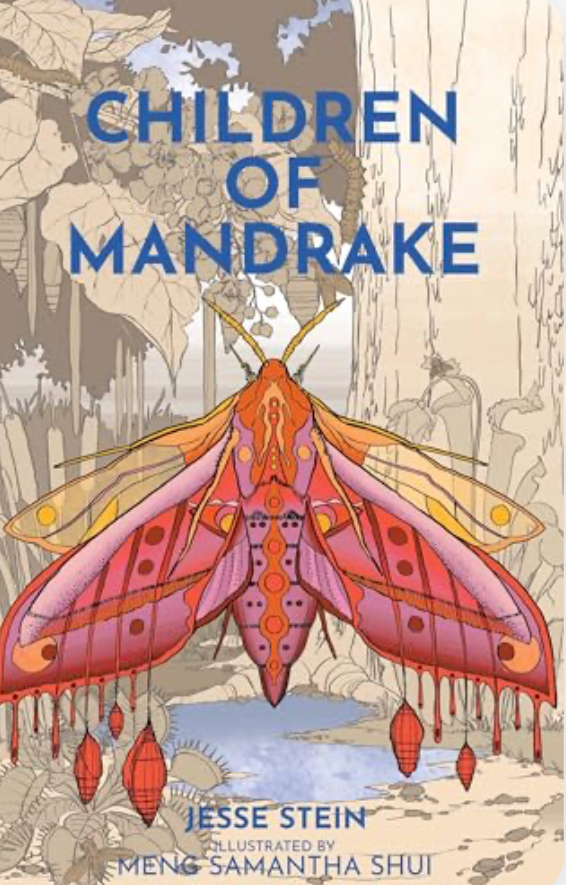
Book Title: Children of Mandrake
Author: Jesse Stein
Illustrator: Meng Samantha Shui
Rating: ⭐️⭐️⭐️⭐️⭐️
Jesse Stein’s Children of Mandrake is a lush, uncanny, and wildly imaginative journey into a town where folklore breathes through the rain and even dessert can send you on a hero’s quest. Gorgeously illustrated by Meng Samantha Shui, this Southern Gothic coming-of-age fantasy is steeped in metaphor, memory, and mud—a triumph of storytelling voice, world-building, and emotional resonance.
Told through the observant, anxious lens of 14-year-old Truman Lowell St. Nectarine, the story begins with the odd but cozy rhythms of life in the rain-soaked town of Mandrake, a place where rivers loop without purpose and legends creep into everyday speech. Truman is a loner, shaped by grief and quiet longing, and his only companion is the razor-sharp, conspiracy-prone Donna, who says things like, “Bagman’s been snatching up all the animals in Mandrake and making bags out of their skin. He’s saving the fish for last.” Their banter is often hilarious, but it’s also layered with a wistful loneliness. “No one talks to us because we’re the only kids in a town full of grown-ups,” Donna explains, “and kids and grown-ups don’t have anything to talk about.”
That loneliness—and the weight of unspoken grief—permeates Truman’s life. His mother, now deceased, “sleeps under the barn floorboards,” and his father is long gone. Truman’s journey begins not with a grand prophecy, but with pie—pecan pie, to be exact. When the mystical Aunt Ginny (Donna’s enigmatic, moss-covered mother) declares that she needs “the perfect cinnamon” for a “special special pecan pie,” the children are sent on a quest downriver. But what starts as a whimsical errand quickly becomes a shadowy voyage through myth, memory, and danger.
The pacing of Children of Mandrake drips slowly, like the perpetual rain soaking its pages—measured and contemplative. Yet it’s precisely this tempo that allows the reader to linger in the strange magic of Stein’s world. Mandrake’s voice-driven narration is its strongest gift. Stein blends the absurd with the profound: “What kind of man uses fish skin to make a bag?” Truman asks early on, just before stepping into a world where haunted rivers, living houses, and sentient taxidermied gator flashlights are all taken seriously.
Yes, a taxidermied flashlight. Regina, the glowing gator pup, becomes a symbolic and literal guide, providing eerie, conditional light only when most needed. “Regina shines when she needs to,” Aunt Ginny tells Truman. “She’ll show you what you can’t see, take you where you can’t go.” In this way, the story dances with metaphor—about grief, about seeing the truth behind what scares us, about letting go.
The prose is musical and strange, full of metaphor and Southern folklore. Stein’s world echoes with voices of the past and whispering trees, where “the rain announces itself on the roof like ahem ahem,” and houses “puff up” before storms. The setting is a character unto itself, and Shui’s illustrations only deepen the atmosphere, blending fog, shadow, and organic textures to mirror Stein’s prose.
For fans of Neil Gaiman’s The Graveyard Book, Kate DiCamillo’s The Miraculous Journey of Edward Tulane, or even Patrick Ness’s A Monster Calls, this book will feel familiar yet entirely original. It revels in emotional honesty and layered storytelling. Truman’s reluctant heroism is both humorous and heartbreaking. When asked by Aunt Ginny what his late mother would think of the man he’s becoming, Truman says bitterly, “She doesn’t think about nothing anymore.” That grief, that rawness, pulses beneath every surreal twist in the road.
Ultimately, Children of Mandrake is about what’s lost and what grows in its place. As Aunt Ginny tells Truman, “You’ve got grit, Truman St. Nectarine. That you’ve got, baby.” It’s a book about remembering, about looking directly at what scares you most—and deciding to go anyway. As Truman says, in a moment of aching resolve: “Just because you’re scared of something and dead doesn’t mean I need to be scared of it too.”
This is a story for middle-grade readers ready for complex themes, teens who appreciate strange, poetic narratives, and adults who love children’s literature that respects emotional depth. It’s ideal for fans of quirky, bittersweet tales about friendship, loss, magic, and growing up in the shadow of impossible things.

