Headline:
A Luminous Battle Between Flesh and Spirit in a Post-Apocalyptic Future
Rating
⭐⭐⭐⭐⭐
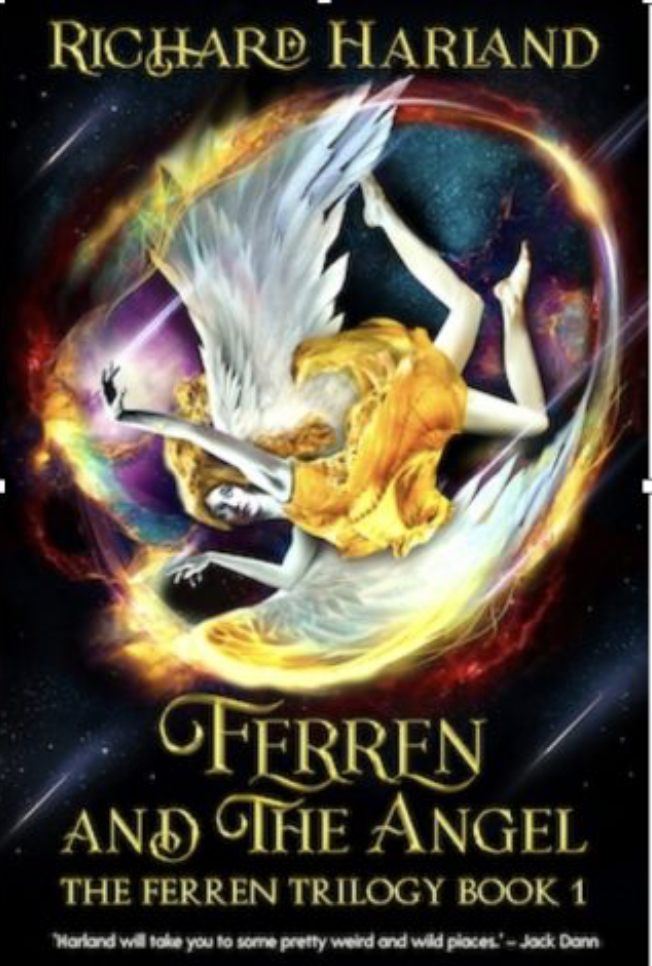
In Ferren and the Angel, Richard Harland delivers a dazzling, high-concept fantasy that blends spiritual warfare, dystopian decay, and unlikely friendship into a narrative that is both thought-provoking and emotionally resonant. Set in a ravaged future where Earth is caught in a cosmic war between angelic Celestials and grotesque, cybernetic Humen, the novel follows fifteen-year-old Ferren, a member of the “Residual” People, a primitive tribe eking out survival in the ruins of civilization. When a wounded angel, Miriael the Fourteenth Angel of Observance, crash-lands near his home, Ferren defies his tribe’s taboos—and his own fear—to care for her. That single act of compassion unravels a lifetime of indoctrination and sets both characters on a path toward rebellion, revelation, and transformation.
Harland’s world-building is masterful. The tribe’s culture, with its rituals surrounding totems like a Baby Jane doll and a can of fly spray, adds a satirical but hauntingly believable layer to the post-apocalyptic setting. The portrayal of the People as backward and docile contrasts sharply with the sterile militarism of the Humen and the holy arrogance of the Celestials. The central tension—between spiritual purity and embodied experience—is embodied in Miriael’s painful acclimation to Earth’s physicality. “It was filth, it was foulness, it was degradation! She was being defiled!” she thinks as she writhes in contact with the soil, underscoring the clash between divinity and the human condition.
Ferren is a compelling protagonist—restless, curious, and emotionally layered. His quiet defiance of his society and his tenderness toward Miriael are deeply moving. The pacing is swift but never rushed, with moments of introspection balancing the broader conflicts. The prose is crisp, poetic, and often darkly humorous. Harland captures both the alien nature of the angel and the crude survivalism of Ferren’s world with striking clarity: “He didn’t think of her as beautiful… She was a miraculous sort of oddity.” And yet, over time, that perspective shifts—as does Miriael’s. Their evolving connection is the beating heart of the story.
Fans of Philip Pullman’s His Dark Materials, Laini Taylor’s Daughter of Smoke and Bone, and Isobelle Carmody’s Obernewtyn Chronicles will find much to love here. Like those titles, Ferren and the Angel explores faith, identity, and the blurred line between good and evil. It’s cerebral without being pretentious, and imaginative without losing emotional grip.
This is the kind of young adult fantasy that respects its audience. Harland doesn’t spoon-feed morality or exposition; instead, he crafts a world as strange as it is logical, one where children worship plastic totems and angels wage war from the skies. With two sequels to follow, this first installment sets the stage for an epic arc that promises to challenge not just its characters, but its readers, too.

