Philip Wride’s Watch Us Play feels like the kind of book parents, teachers, and even policymakers didn’t know they desperately needed until now. At its core, it tackles a modern tension that almost every family recognizes: children are drawn into video games with endless enthusiasm, while adults often view those same games with suspicion, concern, or outright disdain. Wride’s book doesn’t ignore the risks of screen time, but instead reframes gaming as an opportunity—a bridge between play and learning that can transform how children engage with mathematics and problem-solving.
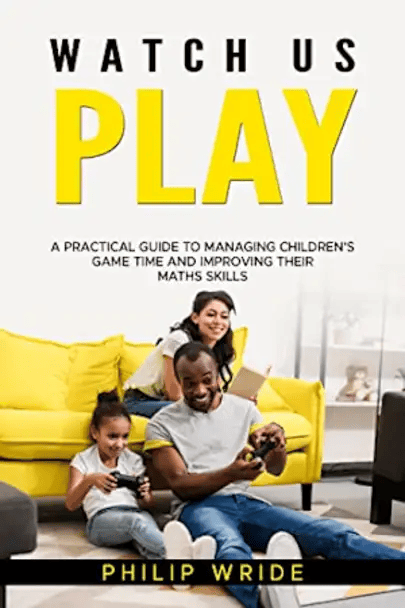
From the very first chapter, the book makes clear that it is not a defense of unchecked gaming, but a call to reimagine its role in children’s lives. Chapter 1 dismantles old myths—like the assumption that games always equal wasted time—and invites readers to see games as a cultural force that, like books or sports, can be harnessed for growth. Wride’s style is approachable, almost conversational, but rooted in research and lived experience, which makes the material both credible and easy to digest.
Chapter 2 introduces esports, moving beyond the image of dimly lit basements to reveal a booming global ecosystem where young players develop teamwork, communication, and resilience. Wride doesn’t glamorize it but explains how scholastic esports programs, in particular, are already shaping education in surprising ways. By Chapter 3, the focus shifts to schools embracing esports more directly. Through real-world examples, he shows how educators are discovering that games can unlock engagement in students who might otherwise be unreachable. These chapters are powerful because they don’t simply assert that gaming has value; they demonstrate how that value is already being realized in classrooms and communities.
Chapter 4 grounds the discussion in the everyday struggles of parents. Device time, family rules, and boundary-setting are presented with empathy, not judgment. Wride acknowledges the chaos of negotiating gaming with children but offers practical strategies like establishing “tech contracts” and reframing limits around natural game pauses. These sections feel especially reassuring for parents who are weary of constant battles around screens. They offer both structure and hope.
Chapters 5 and 6 take a sobering but necessary detour into the state of education during and after COVID-19. Drawing on reports from the World Bank, the National Education Authority, and surveys from the National Education Association, Wride paints a picture of children two years behind in core subjects and educators on the brink of burnout. The tone here is empathetic and realistic. Rather than blaming teachers or parents, Wride points to systemic failures while emphasizing that families and communities now carry part of the responsibility for helping children catch up. This pivot is critical, because it underscores why creative solutions—like game-based learning—are urgently needed.
Chapter 7 may be the most transformative of the book. Wride argues that context matters deeply in education, but not in the way adults often think. While curricula often tie maths questions to “real-life” scenarios like grocery shopping or car repairs, these examples rarely resonate with children. Instead, he suggests anchoring learning in the digital worlds kids already inhabit. Why not frame a multiplication problem through Minecraft blocks or a statistics lesson through Among Us gameplay? Chapter 8 develops this further by linking gaming to the psychological concept of “flow,” the state of deep engagement where time seems to disappear. By aligning learning with the same conditions that create flow in games, children can experience focus and motivation that traditional methods often fail to spark.
By Chapter 9, Wride’s ideas move from theory into practical application. He introduces a five-step framework—Assess, Understand, Introduce, Routine, Reward—that helps parents build a learning structure around gaming. What stands out here is how relational it feels. This isn’t about enforcing maths practice as punishment but weaving it naturally into shared play and family rhythms. Chapter 10 broadens the perspective to long-term parenting, reminding readers that gaming is not a passing phase. For many, it will evolve into communities, creative outlets, or even career opportunities. By reframing games as stepping stones, Wride invites parents to see gaming not as a distraction from life, but as preparation for it.
Chapters 11 and 12 unveil the PARROT Framework, the book’s most distinctive contribution. Born from a scribble in a coffee shop, the acronym—Progression Systems, Achievements, Resources, Rewards, Online Play, and Transactions—captures the common mechanics of almost every modern video game. What makes it brilliant is its adaptability: each of these elements can be directly tied to maths concepts. Progression mirrors growth charts; Achievements map to goal-setting; Resources and Transactions align with arithmetic and economics. It’s a simple but powerful tool, memorable because of both its clarity and its origin story.
The book’s final sections (Parts 3 and 4) are where everything comes together. Chapter 19 demonstrates how Minecraft can become a maths classroom, with blocks and coordinates easily transforming into lessons on area, perimeter, fractions, and ratios. Chapter 22 shows how even fast-paced games like Fortnite can support statistics, percentages, and probability through mechanics like gold bars and star rewards. Chapter 23 then flips the responsibility to parents and teachers, offering clear tips for creating customized resources. Wride shares tricks like modeling from existing maths workbooks, using self-referential word problems (“you have four apples”), and even incorporating game images for visual learners. These chapters are empowering because they shift the reader from passive consumer to active creator.
One of the book’s greatest strengths lies in the interviews interspersed throughout. Clinical psychologist Dr. Bethany Cook, author of For What It’s Worth, emphasizes the importance of understanding a child’s “why” behind gaming and warns against using devices as digital babysitters. Her mantra, “never meet heat with heat,” offers parents a graceful way to handle tantrums and conflict. Child psychologist Carly Dober reframes screens not as villains but as part of modern life, encouraging parents to build structure, consistency, and empathy into family rules. These expert voices elevate the book, grounding Wride’s framework in psychological credibility and reminding readers that gaming is not the root problem—disconnection is.
Wride’s writing is clear, practical, and often personal. He references his partner, friends, and first-hand classroom visits, which makes the book feel rooted in lived experience rather than abstract theory. At times, the tone carries urgency—especially when discussing COVID’s impact or the teacher burnout crisis—but it never slips into alarmism. Instead, the overall feeling is one of possibility: if we shift our lens, games can become tools for connection, confidence, and growth.
Watch Us Play is more than just a parenting guide; it is a call to action. It acknowledges the reality that the education system is struggling, that children are often disengaged, and that parents feel overwhelmed. But instead of despair, it offers a map. By meeting children in the digital spaces they already love, adults can stop fighting a losing battle and start building bridges.
For fans of Jane McGonigal’s Reality Is Broken or James Paul Gee’s What Video Games Have to Teach Us About Learning and Literacy, this book will feel like a natural successor. But unlike purely academic works, Watch Us Play speaks directly to parents and teachers in plain language, providing not just theory but actionable tools.
In the end, Philip Wride delivers a book that is both timely and timeless. As debates over screen time rage on, Watch Us Play charts a middle path—one that neither demonizes nor blindly glorifies gaming. Instead, it insists that games can be what we make of them: lifelines, classrooms, and even catalysts for stronger family relationships.
For parents exhausted by nightly battles over controllers, for teachers searching for new ways to connect, and for anyone invested in children’s futures, Watch Us Play is essential reading. It proves that when we stop seeing play and learning as opposites, we unlock the possibility of both thriving together.

