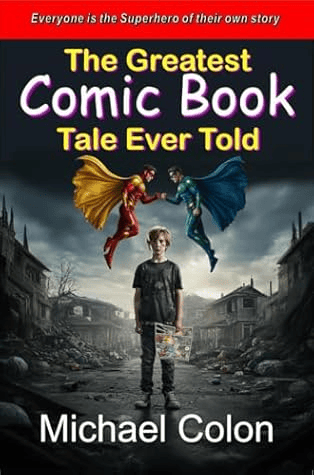
The Greatest Comic Book Tale Ever Told
Michael Colon
Michael Colon’s The Greatest Comic Book Tale Ever Told is a masterful fusion of superhero mythology and deeply human storytelling, a novel that explores the intersection of imagination, grief, and personal destiny. This is the story of Sonny, a young man who is contending with loss, isolation, and moral ambiguity, only to discover the power of love, courage, and self-belief. Colon’s narrative is both a homage to classic comic book epics and a deeply personal coming-of-age story that resonates far beyond the page.
From the prologue onward, the reader is drawn into Sonny’s dual existence: a boy living in the crumbling District Seven and a mind teeming with the heroes and villains of comic lore. Colon does well blurring the line between reality and imagination, creating a tension reminiscent of Neil Gaiman’s The Graveyard Book, where the magical and the ordinary coexist, and between the gritty realism of Bryan K. Vaughan’s Paper Girls, which balances coming-of-age struggles with larger-than-life stakes. The novel’s early chapters establish Sonny’s world with vivid intensity—he is bullied at school, haunted by visions, and isolated from the protective love of family, yet he is never without moments of hope, often catalyzed by the friendships he forges with Marylee and Franklin or the quiet wisdom of Sara, his foster mother.
As the narrative progresses, Colon does not shy away from dark themes. Chapters 5 through 7 confront grief, rage, and the seductive pull of power. Sonny’s transformation into the shadow—a manifestation of his anger and trauma—is portrayed with a psychological depth that elevates the story beyond a typical hero-versus-villain tale. The city of Irontown becomes a character itself, a dystopian reflection of Sonny’s inner turmoil, with scenes of ruin and despair reminiscent of Neil Gaiman’s apocalyptic landscapes or the moral reckonings found in Alan Moore’s Watchmen. Yet through this darkness, the novel never abandons the possibility of redemption, crafting a deep exploration of the choices that define us.
The climax and resolution in chapters 8 and 9 provide an emotionally resonant counterpoint to the darkness. Sonny’s encounters with the angelic figures and the symbolic “Hero of All Heroes” offer a layered meditation on forgiveness, second chances, and the courage to reclaim one’s humanity. These chapters are both thrilling and tender, delivering the payoff of Sonny’s internal journey without relying solely on spectacle. Colon’s prose emphasizes the emotional gravity of the narrative—moments of reunion, lullabies, and personal reflection are as vital to the story as any battle scene.
There are subtle hints at the long-term impact of Sonny’s choices without revealing every detail, leaving readers with a sense of continuity and hope. District Seven’s transformation and the next generation’s arrival highlight the enduring theme that heroism is as much about nurturing community and passing on values as it is about personal power. This narrative choice resonates with fans of superhero fiction who appreciate nuanced worlds, echoing the optimism found in Bryan K. Vaughan’s Runaways while maintaining the high stakes and moral complexity of Moore’s work.
Colon’s novel excels in its ability to balance high-concept fantasy with relatable emotional truth. The Greatest Comic Book Tale Ever Told is not just a story of superhuman feats; it is a testament to resilience, moral courage, and the enduring power of love. For readers seeking a superhero epic that challenges as much as it entertains, Colon offers a deeply satisfying, multilayered experience that definitely lingers.

