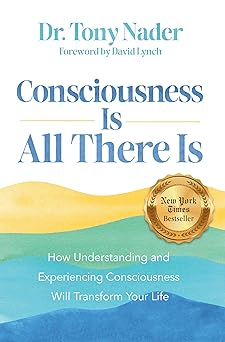
Title: Consciousness Is All There Is: How Understanding and Experiencing Consciousness Will Transform Your Life
Author: Dr. Tony Nader
Publisher: Hay House LLC (2024)
ISBN: 978-1-4019-7650-7
Reviewed by: Demetria Head for A Look Inside
Rating: ⭐⭐⭐⭐
In Consciousness Is All There Is, Dr. Tony Nader explores one of the most profound questions in science, philosophy, and spirituality: what consciousness truly is and how it shapes our understanding of reality. This thought-provoking nonfiction book blends ideas from neuroscience, physics, and ancient Vedic philosophy to argue that consciousness is not merely produced by the brain but is the fundamental field from which all existence arises. For readers interested in books about consciousness, the nature of reality, and the intersection of science and spirituality, Nader’s work offers an ambitious and intellectually engaging perspective.
“An intellectually bold and deeply reflective exploration of consciousness that invites readers to rethink the foundations of reality itself.”
The opening chapters of Consciousness Is All There Is introduce readers to the scientific and philosophical debates surrounding consciousness. Dr. Tony Nader examines how modern science has traditionally approached consciousness as a product of brain activity while acknowledging the challenges scientists face in explaining subjective awareness. Rather than presenting the topic as a technical academic debate, the author provides readers with a broader conceptual framework that invites deeper reflection about awareness and the role consciousness plays in shaping human experience. This section effectively sets the stage for the book’s larger philosophical argument and demonstrates Nader’s ability to communicate complex ideas in accessible language.
As the book progresses, Dr. Tony Nader introduces what he calls the “Consciousness paradigm.” In this framework, consciousness is presented as the primary reality underlying the universe. Drawing on insights from physics and philosophy, the author explores how scientific discoveries have revealed increasing unity among the forces that govern nature. He uses these ideas to suggest that reality itself may originate from a unified field of consciousness. While the book does not claim to provide definitive scientific proof for this theory, it presents a compelling intellectual exploration of the idea and encourages readers to consider alternative perspectives on how consciousness and matter may be connected.
One of the strengths of Consciousness Is All There Is lies in the author’s use of metaphors to make abstract ideas easier to grasp. Nader frequently compares consciousness to an infinite ocean from which waves emerge. Just as waves appear separate from the ocean while still being made of the same substance, the diverse forms of the universe may be expressions of a single underlying field. These analogies help translate complex philosophical concepts into images that readers can visualize and contemplate.
The book also explores the experiential dimension of consciousness. Rather than limiting the discussion to theory, Nader introduces the possibility that individuals can explore deeper states of awareness through contemplative practices such as meditation. In this context, consciousness becomes not only a philosophical concept but also a personal experience that may influence well-being, perception, and self-understanding. These chapters provide readers with insight into how expanding awareness might affect personal development and mental clarity.
“Nader’s interdisciplinary approach elegantly connects science, philosophy, and contemplative wisdom in a way that encourages readers to explore consciousness both intellectually and personally.”
A notable strength of this Tony Nader book is its interdisciplinary perspective. Consciousness Is All There Is connects ideas from neuroscience, quantum physics, philosophy, and spiritual traditions, demonstrating how these different fields often grapple with the same fundamental questions about existence. Nader’s writing balances intellectual depth with accessibility, making the book engaging for readers who may be new to philosophical discussions about consciousness while still offering thoughtful insights for those already familiar with the topic.
At the same time, readers approaching the subject strictly from a scientific standpoint may view some of the arguments as philosophical rather than empirically demonstrated. While Nader draws intriguing parallels between unified field theories in physics and the concept of consciousness as a universal foundation, these connections are presented primarily as conceptual possibilities. Additionally, because the book revisits its central thesis across several chapters, some readers may notice repetition as the author reinforces the idea that consciousness underlies all reality.
Despite these considerations, Dr. Tony Nader’s writing remains engaging throughout the book. His passion for exploring the nature of consciousness is evident in the way he invites readers to reflect on their own awareness and place in the universe. By presenting complex ideas in approachable language, the book opens philosophical discussions about consciousness to a wider audience.
Readers who enjoyed similar works like The Conscious Universe by Dr. Dean Radin or other modern books about consciousness and reality may find Consciousness Is All There Is particularly compelling. While Radin focuses more heavily on experimental research into unexplained phenomena, Nader’s work presents a broader philosophical framework that integrates meditation traditions with contemporary scientific thought.
Ultimately, Consciousness Is All There Is by Tony Nader offers a thought-provoking exploration of awareness and the nature of existence. By combining science, philosophy, and contemplative insight, the book challenges readers to reconsider long-held assumptions about mind, matter, and human potential. For readers interested in nonfiction books about consciousness, personal growth, and the philosophical foundations of reality, Nader’s work provides an engaging and reflective journey into one of the most fascinating subjects of human inquiry.

