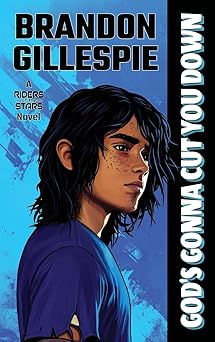
God’s Gonna Cut You Down by Brandon Gillespie
God’s Gonna Cut You Down by Brandon Gillespie opens on the edge of terror and the grip never loosens. The story begins with thirteen-year-old Diego evacuating alongside a crowd of desperate survivors as a Kraal — an extra-dimensional horror — tears through their station. In a moment that defines the rest of his journey, he watches his parents dissolve at its touch, and the creature leaves a psychic imprint in his mind before vanishing. The station’s only hope lies in its ring-to-ring transport network, the Serenity Link, which houses what remains of humanity across five sectors. But instead of comforting him, the evacuees turn on Diego, certain that his birthmarks, violet-flecked eye, and eerie calm mean he is either a growler or tied to the Kraal. What none of them know is that Diego has quietly protected them his whole life — gifted with the ability to sense void terrors and “mask” himself from their awareness. That unspoken guardianship makes his exile even more tragic. Labeled a monster and cast into the abandoned lower rings by a ruling zealot named Carlos, Diego is forced to survive alone amid the ruins — where broken echoes of civilization still cling to the walls. His mission is not chosen but weaponized: find the Kraal and destroy it, or die in the shadows carrying a burden no one else has the courage to face.
The emotional strength of the novel lies in how it widens from spectacle into something deeply human. Gillespie doesn’t just give us a dystopian threat — he gives us the loneliness of being feared for the very gift that keeps others alive. Through Diego’s flashbacks to Donna, the only girl who ever treated him with kindness, we see what acceptance once felt like and why its absence weighs so heavily now. The characters around him are sharply drawn: Raphael embodies cowardly groupthink; Carlos wields faith like a chain; Miguel retreats in silence rather than risk defending a friend. Diego is written with a balance of fragility and instinctive resilience — still a boy, but a boy who stands between oblivion and everyone else. The world-building is delivered with a cinematic slowness that works in its favor: each ring is distinct in culture, religion, and aesthetic, from the devotional iconography of Bravo Ring to the quiet rot of the abandoned Delta and Echo corridors known as the lower rings. The Kraal itself remains terrifying not just because it kills, but because its nature tilts into the eldritch — unknowable, invasive, almost theological in its inscrutability. The style feels modern and atmospheric, reminiscent of works like Scythe by Neal Shusterman — a YA dystopian world built around spiritual dread, moral authority, and young protagonists pushed into impossible roles — only here the threat is cosmic rather than institutional. Like Scythe, this book asks what it means to be chosen — not as a savior through glory, but through suffering and isolation. In every scene, Gillespie leans into tension and emotional texture, pairing visceral imagery with a sense of spiritual dislocation that lingers. It’s not just an apocalyptic story — it’s a haunting study of what happens when a society feels safer blaming its protector than facing the darkness at its door.

