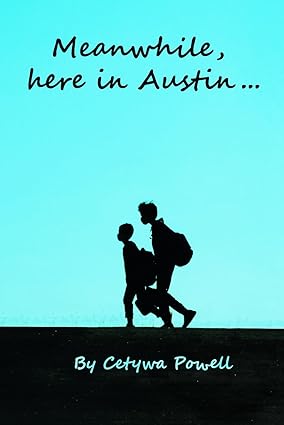
Meanwhile, Here in Austin by Cetywa Powell
Rating: ⭐️⭐️⭐️⭐️⭐️
Meanwhile, Here in Austin by Cetywa Powell, is a reflective, photographic memoir that documents the seasons, emotions, textures, and quiet revelations of life in Austin through the eyes of a transplant learning to belong. Told in four seasonal movements—Spring, Summer, Fall, and Winter, the book blends lyrical personal essays with photography that captures both the city’s geography and its emotional atmosphere. Spring is a study in discovery, from the deer that “won me over” during a house-hunting trip to the stunning bluebonnet blooms and the drama of thunderstorms.
Summer shifts from wonder to immersion: swimming holes, Tex-Mex culture, heatwaves, and the glory of Texas barbecue. Powell’s story pauses for a contemplative chapter on Covid, documenting how isolation, emptiness, and Texan identity collided in a year that changed the city’s rhythm. Fall is rooted in culture—live music, art installations, pumpkin nights, and conversations with strangers who map the city as much as architecture does. Winter, by contrast, is introspective and haunting: the 2021 freeze, days without power or water, the 2023 ice storm, mortgages and rent doubling, and the quiet vulnerability of a city unprepared for disaster. By the final pages, Austin is neither mythologized nor glamorized—it is lived-in, imperfect, and emotionally real, a place discovered through weather, art, small rituals, and human connection across seasons.
What makes the book especially successful is Powell’s hybrid style—part travelogue, part personal diary, part visual ethnography. The tone is intimate, reflective, and observant, carried by a photographer’s instinct to notice what others overlook: deer at daybreak, cicada husks, puddles reflecting glassy skyscrapers, or the stillness of neighbors standing beside fallen oak branches after an ice storm. Her voice is gentle but unsentimental, conveying affection without romanticizing the city. In that sense, it resembles books like Annie Dillard’s Pilgrim at Tinker Creek or Vivian Gornick’s The Odd Woman and the City, but with a distinctly contemporary Southwestern lens. Readers who enjoy The Anthropocene Reviewed by John Green or H is for Hawk by Helen Macdonald—works that braid place, memory, and observation—will find parallel pleasures here. Powell’s Austin is not the tourist’s Austin; it is the lived Austin, where “a city is defined by its people,” a truth she illustrates through vignettes of musicians, neighbors, and everyday encounters rather than skyline glamour.
It also stands apart from more journalistic “city portraits” because it refuses to flatten Austin into a brand. Instead, Powell treats the city as something evolving—beautiful yet precarious, generous yet transient, comforting yet unpredictable. The Covid section is a quiet fulcrum in the book; readers feel the psychological shift from discovery to uncertainty without dramatization. The prose remains steady, intimate, almost confessional. A lesser work might rely on sweeping declarations about Austin’s identity, but Powell’s technique is to show it—through waiting for the bats that never come, through conversations at the Day of the Dead party, or through standing shoulder-to-shoulder with a stranger after a storm. The effect is immersive and contemplative, and it may especially appeal to readers drawn to memoirs of place, newcomers adjusting to relocation, or creatives who experience cities through texture, light, routine, and weather rather than statistics or tourism.
If there is any limitation to the book, it is that its quietness may not satisfy readers seeking a dramatic arc or conventional plot; it is less a narrative than a deep emotional mapping of belonging. Yet that restraint is also its artistry. Powell invites the reader not to watch Austin, but to arrive inside it—to move through its seasons as she did, accumulating meaning the way light accumulates through a lens. In an age where cities are often summarized by branding or skyline shots, Meanwhile, Here in Austin feels refreshingly human-sized: a meditation on place as relationship, earned through attention, tenderness, and time.

