Rating: ⭐⭐⭐⭐
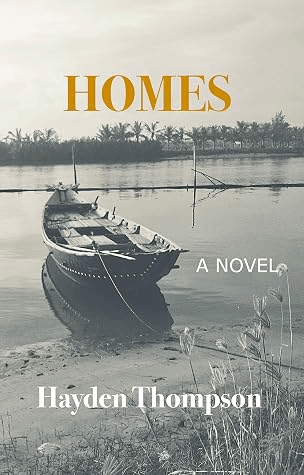
Hayden Thompson’s Homes is the kind of novel that had me thinking about the meaning of its title even before I reached the end. The story begins in 1995 with forty-two-year-old Dr. George Harrington preparing to leave France for a public-health position in Asia. George is divorced and raising his twelve-year-old son, Hugo, so what might have been a straightforward career move becomes something much more personal. He wants a fresh start, meaningful work, and financial stability for Hugo’s education, but he also knows he is asking his son to leave friends, grandparents, and everything familiar behind. That mixture of excitement and guilt is there from the beginning, and it becomes one of the threads Thompson carries through the entire novel. Over the next twenty-two years, George moves through different stages of parenthood, work, loss, friendship, retirement, and travel, and eventually begins to understand that the places we call home are tied just as much to the people and emotions within them as they are to geography.
“Homes turns one man’s life across continents into a thoughtful reminder that the places we leave can remain with us long after we are gone.”
What I enjoyed about Thompson’s writing is that this feels less like a heavily plotted novel and more like sitting down with someone who has lived an unusually full life and is telling you about it over coffee. George narrates his own story, and he notices everything—the weather, meals, streets, conversations, cafés, landscapes, transportation, local customs, and the personalities of the people he meets. That detail gives the book a strong travel-fiction quality, and there were times when I could easily picture the places he was describing. Thompson also gives the story room to move slowly, which I think readers should know going in. This is not a novel driven by one major conflict or dramatic twist. It is more interested in how a life takes shape through a series of choices, departures, reunions, and everyday experiences. Even in Chapter 6, George begins thinking of his workplace as a kind of second home because of the people and sense of belonging he finds there. That becomes important because Thompson keeps expanding the definition of “home” as George’s life changes.
The relationship between George and Hugo was the part of the book that stayed with me most. George is clearly a loving father, but Thompson does not make him a perfect one. His public-health work matters deeply to him, and sometimes his professional responsibilities clash painfully with the responsibility he feels toward his son. One of the best examples is when George is delayed returning from a field assignment and finds Hugo sitting alone outside his school after dark. George realizes that Hugo’s fear goes much deeper than simply being inconvenienced. His mother has already left his life, so the possibility that something might have happened to his father leaves him terrified. Later, when Hugo leaves Asia to continue his education in England, father and son face a completely different kind of separation. George helps him settle into his new room while both struggle with the reality that they will no longer be living together. Hugo’s framed photograph of the two of them and his question about whether his father will call often make that farewell especially tender. I liked watching their relationship mature because George eventually has to learn something every devoted parent faces: loving your child also means allowing him to build a life that no longer revolves around you.
“Thompson understands that home is not simply where we live; it is where love, memory, and belonging continue to find us.”
That idea really comes into focus as George gets older. The first part of the novel is largely about raising Hugo while trying to build a meaningful career, but later the question changes: Who is George when Hugo no longer needs raising and work no longer organizes his days? In Chapter 24, after retiring and returning to England, he has prepared a house for family visits, yet the rooms still feel strangely empty because Hugo and his wife are establishing their own life in Germany. George has left a career that defined him for decades and now has to figure out what comes next. I thought this was one of the strongest themes in the novel because Thompson does not treat retirement as an instant happy ending. Freedom can also be lonely. Travel becomes important to George, as do the friendships he forms along the way, but the book never suggests that simply going somewhere beautiful fixes everything. By Chapter 30, when Hugo has become a father himself, George discovers another kind of belonging through his granddaughter Grace. That experience leads him to think again about the value of being near the people he loves, even after years of becoming comfortable with independence and solitary travel.
The pacing is probably going to depend on what kind of reader picks this up. Thompson organizes the novel chronologically in four parts spanning 1995 to 2017, so we are essentially moving through more than two decades of George’s life. I liked that structure because it lets us see the gradual shift from fatherhood and career ambition to separation, aging, retirement, wanderlust, and reflection. At the same time, the novel spends quite a bit of time on travel details, professional experiences, and descriptions of places. Readers looking for a fast-moving plot may find some portions slower than others. I viewed those passages differently because George is such an observant character that the places themselves become part of his emotional journey. Italy, England, Asia, Belgium, Germany, and the other destinations are not just stops on an itinerary. Each represents a certain period of his life and often a person, friendship, loss, or memory attached to it. By the final chapter, George can look back on “place after place, home after home” and recognize that movement itself has become part of how he understands his life.
Overall, I found Homes to be a gentle, thoughtful contemporary novel about family, expatriate life, work, aging, grief, friendship, travel, and our lifelong search for belonging. George is not an extraordinary hero in the traditional sense, and I think that is exactly why his story works. He is simply trying to make the best decisions he can at each stage of life, sometimes getting it right and sometimes realizing later what those choices cost him. Near the end, one of his most meaningful realizations is that even when he is physically alone, he carries other homes within him because they hold the people and memories that matter to him. Homes reminded me of Jhumpa Lahiri’s The Namesake, not because the two stories are identical, but because both examine family across countries and generations, the pull between one place and another, and the way our understanding of home changes as children grow up and parents grow older. Thompson approaches those ideas through an internationally mobile father whose career keeps taking him elsewhere, which gives Homes more of a travel-centered, expatriate perspective. I would recommend it to readers who enjoy reflective contemporary fiction, family stories, international settings, and novels that are less concerned with a dramatic destination.

