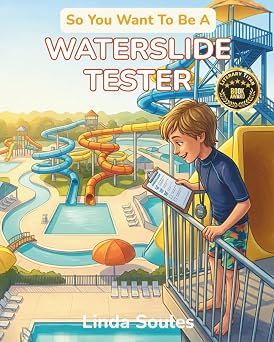
So You Want to Be A Waterslide Tester by Linda Soules
Rating: ⭐⭐⭐⭐⭐
So You Want to Be a Waterslide Tester by Linda Soules is probably one of the most interesting books I have read in this career series so far because, honestly, who knew that waterslide testing was an actual job? The title alone immediately made me curious. I initially imagined someone spending the day riding waterslides and deciding whether they were fun. Soules quickly shows readers that there is much more to this unusual profession. Waterslide testers are responsible for evaluating safety, speed, water flow, comfort, forces, transitions, and even how a rider lands at the end of a slide. Suddenly, a day at the water park looks a little different when you realize how much work happened before anyone was allowed to climb those stairs and take that first ride.
“Linda Soules turns one of the most unexpected jobs imaginable into a fascinating look at the science, skill, and responsibility behind every thrilling ride.”
One of the things I enjoyed most about this book was learning about the science behind something most of us probably never stop to think about. Soules explains that a waterslide is essentially a physics machine. Gravity gets you moving, friction slows you down, and water plays an important role in controlling the interaction between your body and the slide. I was especially surprised to learn just how important the amount of water flowing through a slide actually is. Too little can increase friction and make the ride rough or dangerous, while too much can cause a rider to move too quickly or even hydroplane. I think this is where Soules’ narrative style works especially well. She takes concepts like gravity, friction, water pressure, speed, and force and places them inside an experience children already understand—going down a waterslide. Young readers may not even realize how much science they are learning because they are too busy imagining the ride.
The “Tools of the Trade” section was another favorite of mine because this is where the career becomes even more fascinating. Soules introduces flow meters, pressure gauges, timing systems, surface testers, instrumented suits with pressure sensors and accelerometers, and weighted test dummies used before certain human test runs. Yet with all of that technology, one of the most important instruments is still the tester’s own body. A trained tester can feel subtle changes in vibration, water spray, speed, and landing impact that equipment may not capture in quite the same way. I thought that was fascinating because it shows young readers that technology and human observation work together rather than one replacing the other.
Of course, Soules doesn’t take the fun out of the job. The “Best Parts of the Job” section acknowledges exactly what children are probably thinking—yes, riding waterslides for a living really can be as fun as it sounds. But I liked the distinction Soules makes between the ride and the work surrounding it. A tester may have an exhilarating thirty seconds flying through a slide, but the rest involves measuring, documenting, inspecting, climbing stairs, making adjustments, and doing it all over again. Sometimes the same slide may be tested more than one hundred times before opening day. The exciting ride is almost the reward for all of the careful work surrounding it.
What stood out to me even more was the responsibility of being the person who goes first. Before children and families ever ride a new waterslide, someone has to test it. Soules compares this responsibility to other professions where someone must test something before the public can safely use it. I think this gives the book more depth than its fun title might suggest. The “A Day in the Life” section really helped me picture myself doing this job. Imagine starting your morning in a nearly empty water park before the crowds arrive, meeting with engineers and the safety team, and then climbing to the top of a slide that hasn’t been certified yet. You ride it several different ways, take notes after every run, notice that something doesn’t feel quite right in a turn, and report it. Later, a hydraulic engineer adjusts the water flow and you ride the slide three more times to see whether the change worked. By the afternoon, another slide passes its certification runs, and then comes the part that really puts everything into perspective—you sign the report stating that the slide is safe. That signature carries a tremendous amount of responsibility.
“Behind every carefree splash is a professional whose careful work helps make sure families can simply enjoy the ride.”
I also enjoyed how Soules connects the job back to the people waterslide testers are ultimately helping. Their work may be invisible to the families enjoying a water park, but that is actually the point. If everything has been tested properly, a child gets to fly down a slide, splash into the pool, laugh, and run back to do it again without ever knowing the names of the people who made sure it was safe. I thought this was one of the most meaningful messages in the book because it teaches children that some very important careers involve protecting people quietly, without recognition or applause.
Soules also gives young readers a clear idea of the qualities needed for this profession. A good waterslide tester needs to be observant, systematic, calm under pressure, precise when communicating, and willing to say that a ride isn’t ready even when everyone wants it to open. I especially liked the section about learning to translate physical sensations into useful information. Instead of simply saying that a turn “felt weird,” a professional tester must be able to explain exactly where and how the force changed so an engineer knows what to fix. That is such an interesting skill, and it helps children understand the difference between simply experiencing something and learning how to evaluate it professionally.
The illustrations are colorful, exciting, and probably some of the most appealing in the series for young readers. The towering slides, twisting tubes, splash pools, testers wearing specialized equipment, and behind-the-scenes engineering scenes make the career feel like an adventure. I also enjoyed the historical examples, especially learning about Tommy Lynch, who worked as an official slide tester for First Choice Holidays and traveled thousands of miles visiting resorts and testing their slides. Soules also introduces readers to professional testing teams that combine engineering analysis with actual human ride testing. These examples reinforce one of the most surprising things about the entire book: this unusual-sounding career really exists.
Overall, So You Want to Be a Waterslide Tester is a fun, informative, and surprisingly thought-provoking introduction to a career most children probably don’t even know exists. Linda Soules takes something children already associate with summer fun and uses it to introduce physics, engineering, observation, teamwork, communication, and public safety without making the material feel like a science lesson. I would recommend this book for young readers who love water parks, science, engineering, thrill rides, problem-solving, or discovering unusual careers. After reading this book, I don’t think I’ll ever look at a waterslide quite the same way again. Somewhere, before all the screams, splashes, and laughter began, someone had to climb those stairs and go first.

