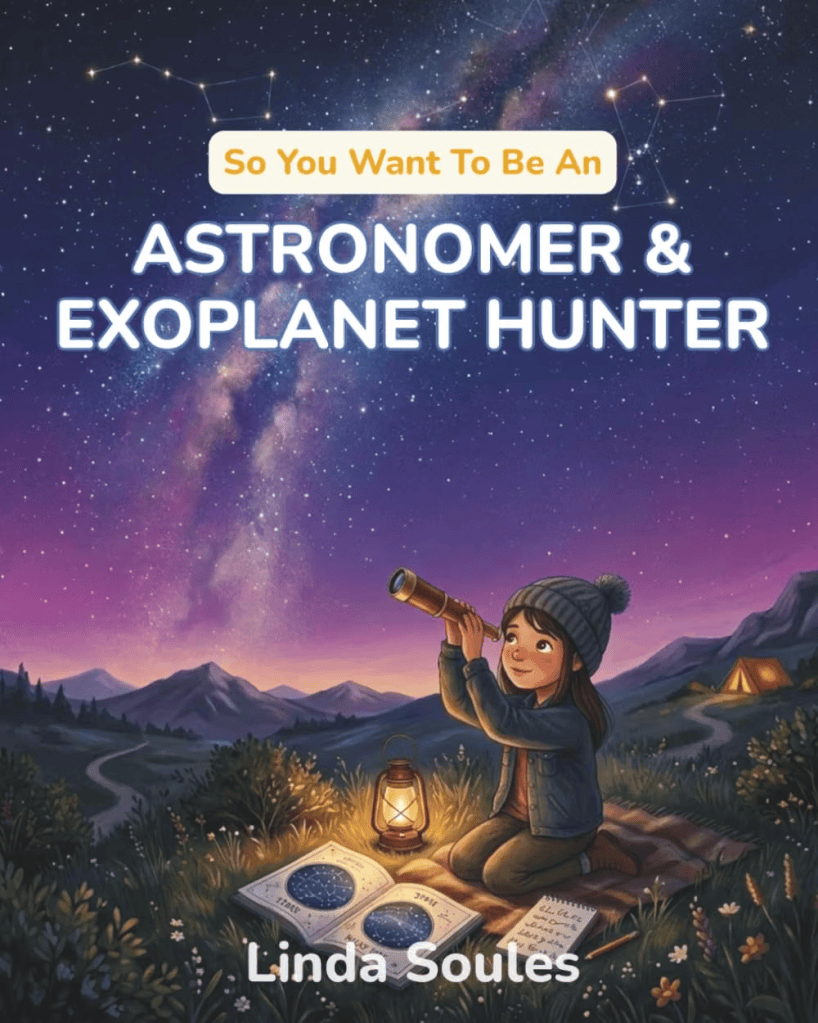
So You Want to Be an Astronomer & Exoplant Hunter by Linda Soules
Rating: ⭐️⭐️⭐️⭐️⭐️
So You Want to Be an Astronomer & Exoplanet Hunter by Linda Soules is a fascinating introduction to a career that involves studying some of the biggest mysteries imaginable. This book takes young readers far beyond the familiar picture of an astronomer simply looking through a telescope. Instead, Soules shows us scientists who study light, analyze enormous amounts of data, write computer code, work through the night, and patiently search for planets orbiting stars so distant that we may never physically reach them.
One thing I really enjoyed about this book is the sense of wonder Soules creates from the very beginning. Astronomy deals with distances that are almost impossible to comprehend. The Sun is about 93 million miles from Earth, yet its light reaches us in only about eight minutes. The nearest star beyond our Sun, Proxima Centauri, is so far away that its light takes more than four years to reach us. Even more amazing is the idea that when we look deeply into space, we are also looking backward in time. The light reaching us from the Andromeda Galaxy began its journey millions of years ago. These facts immediately give young readers a sense of just how enormous the universe really is.
“Soules turns the night sky into something more than a beautiful view—she turns it into a mystery waiting for the next generation of scientists to solve.”
I was especially interested in learning how astronomers actually discover exoplanets. Since these distant planets are usually too small and far away to photograph directly, astronomers often watch the stars instead. When a planet passes between its star and us, it blocks a tiny amount of the star’s light. If that dimming happens repeatedly at regular intervals, scientists may be seeing the signature of an orbiting planet. The book calls this a transit, and the resulting pattern is a light curve. I thought this was such an interesting concept because astronomers can discover something they cannot actually see by carefully measuring what happens to the light around it.
The tools astronomers use were another surprise. Of course, telescopes remain extremely important, but today’s astronomers also depend heavily on computers, mathematics, statistics, and coding. Soules explains that Python and even machine learning have become important tools because a single space telescope can produce terabytes of information. Scientists need programs capable of sorting through all that data and separating meaningful signals from ordinary noise. The book also introduces spectrographs, which separate light into its component colors and allow astronomers to learn astonishing things about a distant star, including its temperature, chemical composition, and movement.
The section on space telescopes made the science even more exciting. Soules discusses the James Webb Space Telescope and explains how extremely cold it must remain to detect faint infrared signals from distant worlds. She also introduces TESS, the Transiting Exoplanet Survey Satellite, which scans the sky searching for nearby stars with planets. I think sections like this will help children understand that astronomy isn’t only about discoveries made hundreds of years ago. This is a rapidly developing field in which new discoveries are still being made.
I also appreciated the honesty of “The Hardest Parts of the Job.” Astronomy requires tremendous patience. Weather can destroy an entire week of planned observations. A satellite can cross a telescope’s field of view at exactly the wrong time. Scientists compete for limited telescope time and research funding, and what initially looks like a planet may turn out to be an instrument problem, noise, or something else entirely. Some discoveries require years of observations before scientists can be confident about what they have found. Soules presents persistence as part of science itself: astronomers keep observing, analyzing, questioning, and trying again.
That makes the discovery itself seem even more rewarding. I loved the description of an astronomer realizing that the quiet pattern on a computer screen represents a world no human being has ever known existed. There may be no dramatic explosion or flashing announcement—just data finally making sense. Yet that scientist could be the first person in human history to know that particular planet is there. I can imagine how extraordinary that moment must feel.
The “A Day in the Life” section gives young readers a realistic look at the unusual schedule of observational astronomy. The day may begin at 4:00 in the afternoon, with the astronomer waking at the observatory and preparing for the night’s work. Observations continue through midnight and into the early morning, with data being checked as it arrives. By 4:30 a.m., dawn approaches and the dome closes. Then, while much of the world is beginning its day, the astronomer sleeps. This section made the profession feel much more real because children can imagine what living that schedule would actually be like.
Another excellent point is that astronomy is collaborative. Discovering an exoplanet can involve observers, instrument specialists, theoretical astronomers, statisticians, graduate students, telescope operators, software engineers, science writers, and many others. Soules makes it clear that major discoveries are rarely the work of one person sitting alone beneath the stars.
I particularly enjoyed the historical section. Young readers meet Caroline Herschel, who discovered eight comets and became the first woman ever paid as a professional scientist by the King; Vera Rubin, whose observations provided powerful evidence for dark matter; Michel Mayor and Didier Queloz, whose discovery of 51 Pegasi b helped transform exoplanet science; and Natalie Batalha, who led the science team for NASA’s Kepler mission. I especially liked learning that Batalha began college as a business major before a physics class changed her direction. That is a wonderful reminder to children that they do not necessarily have to know their life’s path from the beginning.
The fun facts may be some of the most memorable pages for younger readers. Imagine a world where iron rains from the clouds sideways because of tremendous winds, or another planet where winds carry tiny glass particles at more than 5,400 miles per hour. There are even planets orbiting two suns, meaning that from their surfaces you could theoretically watch two sunsets. These facts sound like science fiction, which makes it even more exciting that they concern actual worlds astronomers have discovered.
“Perhaps the most inspiring message in this book is that the universe is enormous, but a curious child does not have to wait until adulthood to begin exploring it.”
I loved that Soules gives children practical ways to begin right now. They can learn constellations, use a star chart, visit a planetarium, learn basic coding, take math and physics seriously, read about space, or participate in citizen-science projects that allow ordinary people to examine real telescope data. A child doesn’t have to own a professional observatory to begin developing the curiosity and skills of an astronomer.
The illustrations throughout the book are beautiful and help communicate both the enormous scale of space and the human side of astronomy. We see observatories perched on mountains, glowing computer screens displaying data, diagrams explaining planetary transits, distant worlds, scientists working together, and children looking upward through telescopes. The visuals make some fairly complicated scientific concepts much more approachable.
Overall, So You Want to Be an Astronomer & Exoplanet Hunter is an engaging combination of career exploration, astronomy, science, and inspiration. Linda Soules doesn’t simply tell children that astronomy is exciting; she shows them why, while also being truthful about the patience, mathematics, technology, skepticism, and persistence the profession requires. I would highly recommend this book for young readers fascinated by stars, planets, computers, science, or the possibility of life elsewhere in the universe. It leaves readers with one especially exciting thought: somewhere in all that darkness, there are still worlds waiting to be found—and perhaps one of today’s curious young readers will be the person who finds the next one.

