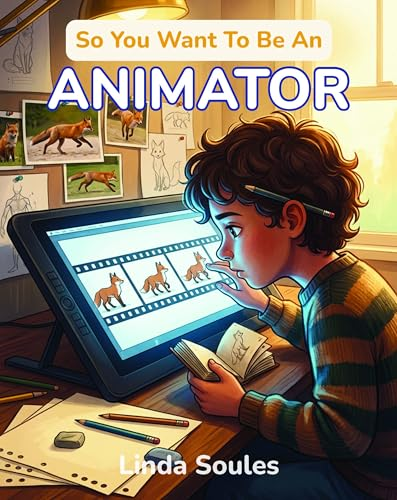
So You Want to Be an Animator by Linda Soules
Rating: ⭐⭐⭐⭐⭐
So You Want to Be an Animator by Linda Soules takes young readers behind the scenes of something many of them probably encounter every day without thinking much about how it was created. Before reading this book, a child might assume that being an animator mostly means being really good at drawing. I knew there was obviously more to animation than that, but even I found myself thinking differently about animated characters after reading Soules’s explanation of what actually makes them feel alive. Animators aren’t simply artists. They are observers, actors, storytellers, students of movement and physics, and people with an extraordinary amount of patience. Their job isn’t just to move a character across a screen. It’s to somehow convince us that something made from lines, shapes, or pixels can think, feel, hesitate, react, and have a personality.
One of my favorite parts of the book was Soules’s description of an animator as five things at once: an actor, physicist, timekeeper, observer, and marathoner. That may be one of the best explanations in the book because it immediately shows children how many different abilities come together in animation. An animator might physically act out an expression or movement before drawing it, study how a cat lands or water falls to understand physics, and then manipulate tiny differences in timing to communicate what a character is thinking. I especially liked learning how much a pause can say. A character hesitating for just a fraction of a second before doing something can make us believe that character actually stopped to think about it. That’s such a small detail, but once Soules explains it, you begin noticing animation differently.
“Linda Soules shows young readers that animation isn’t simply about making drawings move—it’s about understanding movement, emotion, and timing well enough to make an audience believe those drawings are alive.”
Soules also gave me a new appreciation for the patience behind animation. A professional hand-drawn animator may complete only about three to five seconds of animation in an entire day. Traditional film runs at twenty-four frames per second, meaning a single second of fully drawn animation can require twenty-four separate drawings, although animators can also work “on twos,” holding one drawing for two frames. Imagine spending an entire day working on only a few seconds of a character’s movement and knowing an audience will watch all those hours of work almost instantly. Then imagine being told the scene has changed and some of it has to be redone. Soules is surprisingly honest about that side of the profession. Revision can mean reworking something you thought was finished, and repetition is simply part of the job. I appreciated that she doesn’t take away the magic of animation while showing children just how much work creates it.
The “Tools of the Trade” section was another part I enjoyed because it brings the old and new sides of animation together. Soules discusses pencils and light boxes alongside digital tablets, software, timelines, and exposure sheets. But what stood out to me most was her explanation that one of an animator’s most important tools is something they already have: their eyes. Animators watch the world. They study how a person walks, how a bird lands, how water falls, and how faces change with emotion. Many even keep a mirror at their desk so they can make an expression themselves, study their own face, and then use it as a reference. I can imagine children having fun with that idea because suddenly making ridiculous faces in the mirror can legitimately be called animation practice.
The “A Day in the Life” section made the profession even easier to picture. Soules follows an animator working on a character lifting a heavy box. The animator begins by filming themselves lifting one, watches the footage repeatedly, and studies where the effort appears in the body. From there come key poses, feedback from a supervisor, computer-assisted in-between movement, adjustments, and finally the tiny details that make the performance believable. I was fascinated by how small those details can be—a slight delay in the fingers, shoulders that continue moving after the rest of the body stops, or a blink just before a major effort. By the end of the day, the animator watches the scene again and still finds things to fix tomorrow. That says quite a lot about the patience this career requires.
I also enjoyed seeing the different forms animation can take. Soules introduces hand-drawn 2D animation, stop-motion using puppets, clay, or cutouts, computer-generated 3D animation, and silhouette and cutout animation. I think this is particularly encouraging for children because it shows there isn’t only one doorway into this kind of creativity. A child who loves drawing may become fascinated with traditional animation, while one who enjoys building with clay or constructing little worlds might discover stop-motion.
The history section was equally interesting. Readers meet Hayao Miyazaki, Lotte Reiniger, Walt Disney, and Floyd Norman, and I liked that Soules chose people who demonstrate very different ways of contributing to animation. Reiniger created The Adventures of Prince Achmed using intricate black-paper silhouettes. Miyazaki’s work demonstrates the power of hand-drawn animation, while Walt Disney’s story illustrates what persistent imagination can build. I especially appreciated the inclusion of Floyd Norman, who became the first Black animator at Disney. Soules explains that he helped animate Sleeping Beauty and The Jungle Book and later worked for decades on Disney and Pixar productions. Together, these stories show children that animation has been shaped by different people, techniques, technologies, and artistic visions.
“Soules celebrates not only the magic audiences see on the screen, but the patience, observation, repetition, and imagination of the artists who create it one tiny movement at a time.”
The fun facts were some of my favorites. One minute of fully drawn animation contains 1,440 frames. Mickey Mouse’s four fingers originated as a practical shortcut because four were faster to draw than five. And Merida’s wild red hair in Pixar’s Brave was so complicated—with 1,500 hand-sculpted curls controlling almost 112,000 individual hairs—that Pixar’s existing software couldn’t handle it. A team developed a new simulator specifically for her hair and named it Taz. These are the kinds of details that could make children go back to their favorite animated movies and start wondering how everything they’re seeing was actually made.
I also liked that Soules doesn’t leave children thinking animation is something they have to wait until adulthood to try. They can make a flipbook, create a simple stop-motion film using toys, clay, LEGO bricks, or other objects, act out movements before drawing them, experiment with facial expressions, or practice drawing the same character repeatedly until they can keep its appearance consistent. That last exercise says a lot about the profession. Drawing a great character once is one thing; drawing that same character again and again while making it look like the same person is an entirely different skill. Best of all, children don’t need expensive software to find out whether animation interests them. As Soules points out, they can start with paper, a pencil, and curiosity.
Overall, So You Want to Be an Animator is an engaging introduction to the creativity, observation, patience, collaboration, and technical skill behind animation. Linda Soules does a great job of preserving the magic of bringing a character to life while showing children that the magic doesn’t happen magically. It takes thousands of tiny decisions about movement, timing, expression, weight, emotion, and storytelling. I would recommend this book for young readers who love drawing, animated movies, storytelling, computers, art, building characters, or simply figuring out how things move. More importantly, it may help a child who is always drawing little characters in the corner of a notebook realize that those drawings don’t necessarily have to stay there. With enough patience, practice, and imagination, they might just learn how to make them move.

