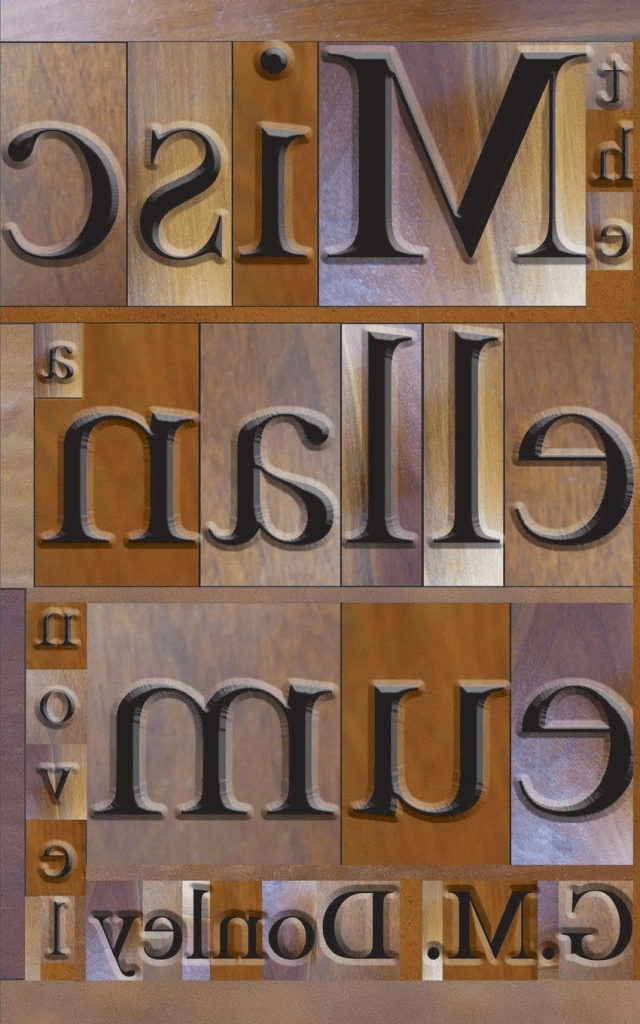
The Miscellaneum by G.M. Donley
Rating: ⭐⭐⭐⭐⭐
G. M. Donley’s The Miscellaneum is a coming-of-age story and a playful take on the detective-agency genre, with mystery, adventure, and plenty of humor mixed in. It follows Evan Erwin, a college student whose education has gotten off track after struggling with engineering. He hasn’t told his parents everything about his failed classes, and he is beginning to realize that subjects like art history interest him more than the path he has been following. A year-long internship at the Miscellaneum gives him an opportunity to step away and figure things out. But this is no ordinary internship. The organization operates from an unusually difficult-to-find building in Cleveland, where Evan meets Mr. Raymond, the Butler, and Dr. Bettina Zabel, the Scientist. At the center of everything is the Considerator, an enormous machine that produces strange assignments ranging from something as ordinary as getting lunch to investigating mysteries involving eighteenth-century portrait miniatures. What begins as Evan trying to figure out his own direction gradually turns into a much stranger adventure.
This story grabbed me because Donley has a way of making the strange feel completely normal. In the opening, Evan is simply trying to find the Miscellaneum for his first day, but the directions alone tell us that this place is going to be different. It doesn’t appear on Google Maps, and Evan has to rely on clues like whether he can hear a train, see Lake Erie, or smell Vietnamese food. Eventually, he follows the smell through an alley and finds “Miscellaneum” carved above the door. I could picture Evan wandering around this part of Cleveland with his broken suitcase while becoming increasingly convinced that he is lost. Then he gets inside and eventually encounters the Considerator, a bizarre machine that helps determine what the Miscellaneum will do. I liked this opening because Donley doesn’t explain everything at once. Instead, Evan discovers the peculiarities of this place at the same time we do.
I thought Evan was developed particularly well because his real problem isn’t that he lacks ability. He doesn’t know what he wants to do with it. Early in the book, he realizes that concepts such as chiaroscuro and pentimenti interest him more than biomedical metallurgy, even though he hasn’t told his parents that he may prefer art history. I liked watching him repeatedly get pulled into subjects and situations outside his experience because that becomes part of his education. The Miscellaneum doesn’t give him a conventional curriculum. He learns by researching, investigating, meeting people, asking questions, and sometimes simply figuring things out as he goes. His relationship with Pug adds another layer to his development. Through her and the other people he meets, Evan begins thinking more seriously about relationships, family, and what he actually wants instead of simply following the direction he thought his life was supposed to take.
Donley’s writing style is very conversational because Evan tells the story through the weekly journal he is required to keep as the Miscellaneum’s intern. That gives the novel a wandering quality at times, but I think that is intentional because Evan records the different things that catch his attention. The story can move from art history and scientific experiments to bicycles, sailing, Cleveland history, music, family, technology, or another unexpected assignment. There is a lot of detail, and this is definitely not a traditional fast-moving thriller. Some readers may feel that certain explanations, side stories, and technical details go on longer than necessary. I didn’t always need every detail myself, especially when the story moved away from its larger mysteries. But I also understood why Donley wrote it this way. All of this miscellaneous information is connected to the novel’s larger idea that knowledge doesn’t always have to fit neatly into one subject to have value.
I also appreciated how important Cleveland and Lake Erie are to the story. They aren’t simply places where the characters happen to live. Donley uses the lake, neighborhoods, industrial spaces, boats, libraries, transportation, local history, and other parts of the region to give the novel its identity. Even some of the stranger assignments become surprisingly emotional. One scene that stood out to me involves Captain Penny taking Evan sailing onto Lake Erie at night. What initially sounds like a suspicious secret transfer turns out to involve a promise Penny made decades earlier concerning his deceased partner, David. Evan has been brought along as an independent witness while Penny finally fulfills that promise and David’s ashes are given a burial at sea. I liked this scene because something that initially seems like another strange Miscellaneum assignment becomes a story about regret, love, and keeping a promise even decades later.
What stayed with me most was the novel’s larger idea of refusing to force every interest, problem, or person into one specialized category. Evan begins the story worried because his life has moved away from the academic path he expected to follow. By the end, Dr. Alaphilippe is encouraging him to pursue different fields of inquiry as he needs them rather than necessarily working toward another specific degree. Evan himself begins to realize that perhaps the real problem was believing there had to be a script for his life in the first place. I thought this brought his story full circle because the very thing that initially makes Evan feel lost—his inability to fit neatly onto one path—eventually becomes one of his strengths.
Overall, The Miscellaneum is a quirky and intelligent coming-of-age adventure about curiosity, knowledge, community, and finding direction when the expected path no longer fits. The mysteries and increasingly unusual situations provide the adventure, but Evan’s transformation gave the story its meaning for me. He begins as a young man embarrassed by what looks like failure and uncertain about where he belongs. He finishes the year much more comfortable with the possibility that a worthwhile life doesn’t necessarily move in a straight line. I also liked that Donley doesn’t completely close the door on the Miscellaneum. Near the end, the group considers shutting it down, but the Considerator unexpectedly produces another assignment without anyone feeding it. Everyone looks at Evan, he goes to retrieve it, and his final thought is that this may be where his journal ends—or where the next one begins. It felt like a fitting conclusion for a novel built around the idea that you never quite know where the next question might lead.

