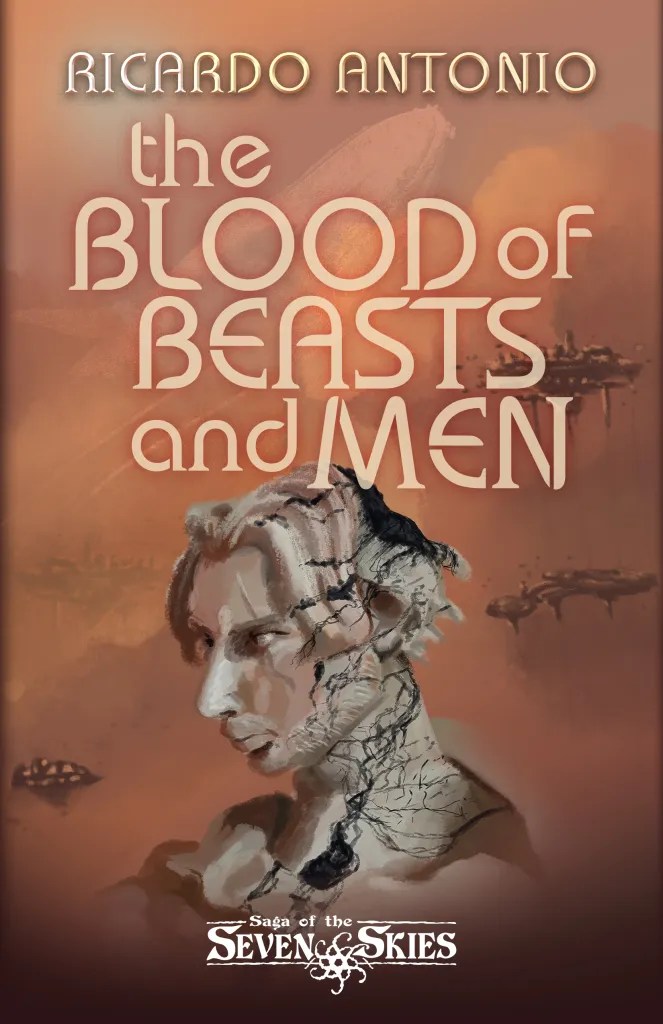
The Blood of Beasts and Men (Saga of the Seven Skies Book One)
Author: Ricardo Antonio
Publisher: Dos (2026)
ISBN: 979-8234271884Rating: ⭐⭐⭐⭐
Headline: A Sweeping Fantasy Adventure Through a World of Power and Betrayal
The Blood of Beasts and Men by Ricardo Antonio is the first book in the Saga of the Seven Skies, a science-fantasy adventure that combines political conflict, piracy, ancient mysteries, and struggles for power. The story takes place in Orbis, a world transformed by a catastrophe known as the Great Boiling, where intelligent animal societies, human descendants, and advanced technology coexist. The prologue introduces Cesar, a human who awakens in a world where powerful Beasts dominate others. His encounter with a fox named Zo and reunion with Isha reveal a troubled history involving the Garden, a project intended to preserve life. From there, Antonio expands the story across the Seven Skies, introducing competing governments, military forces, and individuals whose personal ambitions become entangled in larger conflicts. What interested me most was how the novel explores the difference between having power and deserving to exercise it.
The prologue immediately caught my attention. When three wolves threaten Cesar, their leader insists that strength gives him the right to rule. Zo’s arrival turns that argument against them, making the encounter both disturbing and darkly humorous. I thought this was a clever introduction to the novel’s questions about power and the so-called natural order. The story then shifts to Icarus, whose childhood experiences reveal the cruelty within his noble family. Later, his military service forces him to confront the consequences of political decisions made by those in authority. I liked how Antonio connects these personal experiences to the wider conflict rather than presenting war as nothing more than an exciting adventure.
Antonio’s worldbuilding is one of the novel’s greatest strengths. The flying ships, aerial battles, unusual landscapes, and different cultures make Orbis feel unlike a conventional fantasy setting. In the early chapters, Icarus’s experiences with the Protector Corps and his friendship with Sun Hao introduce both the military technology and the relationships that shape his decisions. The discussions of Sencia, the mysterious force associated with the world’s technology and history, also add another layer to the story. I particularly enjoyed how the author mixes advanced machinery with older traditions, noble houses, religious beliefs, and pirate customs. However, the many unfamiliar terms and competing factions require close attention, especially during the opening sections.
I thought the characters became more interesting as their personal loyalties were tested. Cardan Itono is a good example. His relationship with Erza Lockheart and the consequences of his father’s actions give him emotional struggles beyond his military responsibilities. Later, his interactions with Kazane and Captain Siân reveal a man whose determination can become difficult to separate from his desire for control. I found this particularly interesting because Antonio does not make every decision easy to defend. Midway through the story, Cardan’s handling of suspicion and possible mutiny aboard a ship creates tension through uncertainty rather than action alone. His choices also raise questions about whether someone fighting injustice can begin repeating the behavior of those he opposes.
The later chapters bring the story’s emotional and physical dangers to the forefront. Aven’s experiences aboard Blackbeard’s ship are especially tense because the pirate captain’s ambitions involve more than wealth or control of the skies. His belief that he has received a divine promise gives the conflict a frightening sense of purpose. I also appreciated the scenes involving Aven and Ayla, whose shared experiences of loss help make their relationship believable. Near the end, the aerial confrontations surrounding Blackbeard’s ship are vividly described, with damaged cannons, rapidly moving aircraft, and dangerous maneuvers that are easy to picture. These scenes demonstrate Antonio’s ability to create excitement without losing sight of the characters’ personal stakes.
Antonio’s writing is highly descriptive, particularly when depicting the machinery, landscapes, and battles of Orbis. His dialogue also gives characters distinct personalities, especially through their different speech patterns. I enjoyed the combination of humor, emotional exchanges, and darker confrontations. However, the extensive worldbuilding sometimes slows the story, and the shifts between characters and timelines can make it difficult to immediately understand how everything connects. Some conversations also require rereading because of the unfamiliar vocabulary and stylized dialogue. Readers who enjoy detailed fantasy worlds may appreciate this complexity more than those looking for a straightforward adventure.
I also appreciated the appendices, which provide additional information about the world’s political structure, history, and chronology. The maps and illustrations help readers visualize a setting that would otherwise be difficult to imagine. These materials are particularly useful because the story introduces so many locations, factions, and historical events.
Overall, I found The Blood of Beasts and Men to be an imaginative and ambitious opening to the Saga of the Seven Skies. Antonio combines memorable characters, elaborate worldbuilding, and action with questions about identity, loyalty, freedom, and the misuse of power. Although the amount of information can occasionally overwhelm the narrative, the novel offers plenty for readers who enjoy politically layered science fantasy, complex characters, and adventurous stories set in richly developed worlds.

