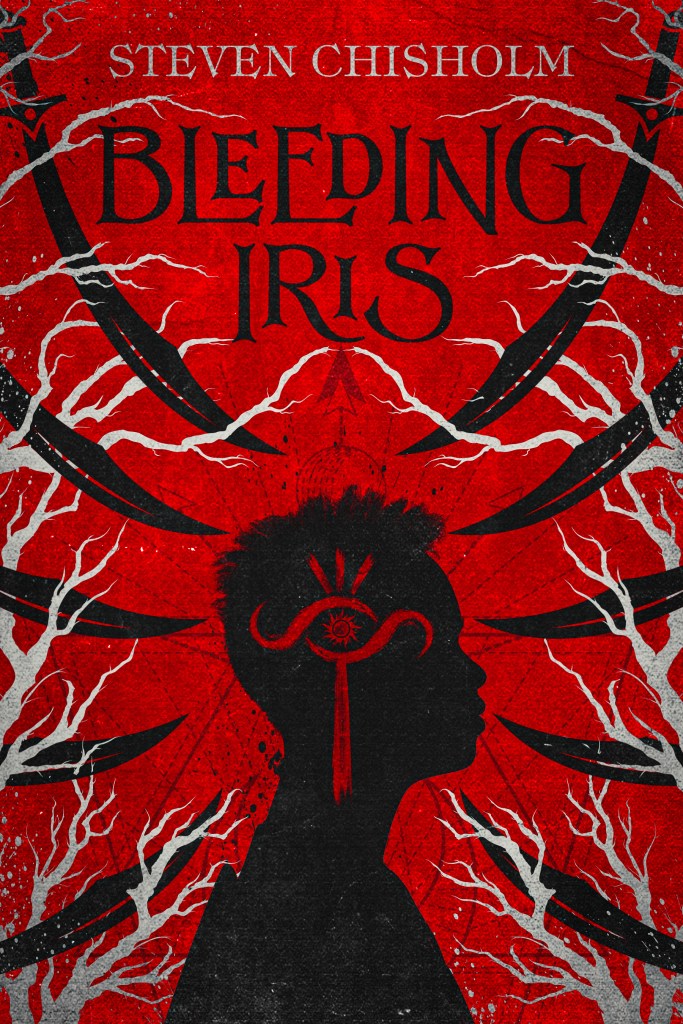
A Gripping Epic of Faith, Power, and the Price of Revolution
⭐️⭐️⭐️⭐️⭐️
Bleeding Iris by Steven Chisholm is a formidable and visionary addition to the epic fantasy canon, weaving moral ambiguity, political unrest, and mythic resonance into a brutal yet poetic saga. With striking prose and haunting philosophical inquiry, this novel doesn’t just tell a story—it challenges readers to confront the cost of power and the shape of belief.
From its chilling prologue—where an immortal guest confronts a treacherous lord—the novel sets its tone with intensity and eloquence. The confrontation ends not with violence alone, but with an unsettling moral lesson:
“Not all rumors are fabrications,” the guest says after surviving an assassination attempt, reinforcing that legends are often born from truth.
He later reflects, “Does your god only fulfill your material desires? Am I not a testament to the superior generosity of Shetani?” establishing a recurring theme: divine power is both a blessing and a blight, depending on who wields it and why.
The story follows Odalig dehn-bal-Ahk, a Shackled Iris—someone born with divine potential but who has yet to accept the terms of the supernatural Bargain. He is not a warrior but a viska, an ideological combatant trained to destabilize enemy cities through rhetoric and manipulation.
His mission is summed up early: “The purpose of words is not to kill but to preserve. However, sometimes the crowd’s a feral beast, and one cannot talk down an angry dog.”
The narrative is full of elegant contrasts like this. Odalig’s eloquence is his weapon, and he uses it to stir dissent among oppressed citizens. His fiery oration in the Hedgeton District is particularly telling:
“No one, not even a king, can wall off the horizon.”
With this line, Odalig turns hope into a weapon, inspiring his audience to revolt without ever mentioning revolution.
Yet Odalig is no clean-cut hero. His demon, visible only at the edge of his vision, whispers condemnations throughout the book:
“Liar. Liar. Liar.”
This omnipresent judgment anchors the reader to Odalig’s inner turmoil—he manipulates others for a supposed greater good, but constantly questions whether he’s any better than the rulers he undermines.
World-building in Bleeding Iris is astonishing in its depth and originality. The city-army of Kana Balerrha—mobile and militant—is a remarkable feat of imagination:
“A child’s impractical concept brought to fruition.”
Its blend of barracks, brothels, and siege weapons paints a picture of a culture always in motion, always at war, always faithful to Shetani. The imagery of “Bleeding Irises”—those who’ve accepted divine power and bear blood-red sclerae—is equal parts beautiful and disturbing, functioning both as literal identifiers and metaphors for spiritual corruption.
Characterization throughout is sharp and layered. Leviticus, the viska mentor, is gifted with the ability to say exactly what people want to hear—but cursed with an inability to feel genuine connection:
“He was incapable of sustaining a relationship. Eternal isolation in exchange for a clever tongue.”
He’s a tragic figure disguised as a charismatic leader, a reminder that divine gifts in this world always come with a price.
Odalig’s love interest, Baldana, a brothel worker from the derelict Trimptan Jans, adds emotional texture to the story. In one intimate moment, she quips:
“Apologizing for sex? What have you done with Odalig, you shapeshifter?”
Her voice grounds Odalig, offering a rare reprieve from the high-stakes world of espionage and war.
One of the most disturbing but important scenes features King Amara’s execution of a pregnant woman—a moment as grotesque as it is thematically vital.
“She raised her chin to give the man a clean target… Blood poured from the opening, a macabre waterfall.”
It is a jarring but pivotal reminder that in the world of Bleeding Iris, mercy and monstrosity often wear the same crown.
While the prose is undeniably rich, the density of invented terms, geography, and political factions may pose a challenge to some readers. A glossary or companion map would assist in navigation without compromising the immersive experience. However, Chisholm manages to ease readers into this complex world with dialogue that feels authentic, and exposition that rarely overreaches.
The ideal reader for Bleeding Iris is a seasoned fantasy fan who enjoys cerebral themes, layered characters, and political allegory. Think readers of R.F. Kuang (The Poppy War), Seth Dickinson (The Traitor Baru Cormorant), or Ken Liu (The Dandelion Dynasty). Those looking for straightforward good vs. evil battles may struggle with the ambiguity, but those who revel in morally grey worlds will find much to savor.
In sum, Bleeding Iris is a fierce, thought-provoking novel that interrogates the nature of belief, identity, and revolution. Its blend of sociopolitical commentary and high fantasy makes it a standout entry in the genre.
“This is not a tale of salvation, but a study in what men are willing to become to justify their gods.”
A quote that encapsulates the heart of this unforgettable book.

