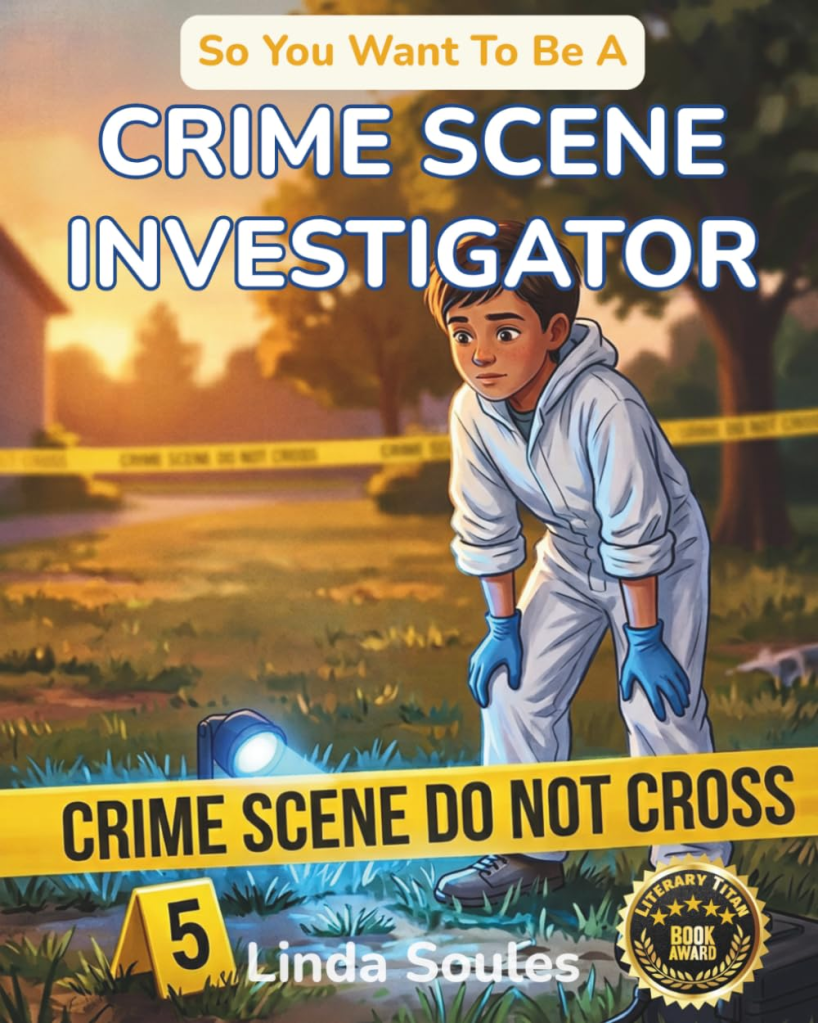
So You Want to Be a Crime Scene Investigator by Linda Soules
Rating: ⭐⭐⭐⭐⭐
So You Want to Be a Crime Scene Investigator by Linda Soules takes young readers beyond the exciting version of crime scene investigation they may have seen on television and shows them what the profession actually looks like. I think there is something naturally fascinating about walking into a room and realizing that almost anything could tell a story if you know how to look at it. A fingerprint, a shoeprint, a fiber, or something that simply seems out of place could become important. Soules uses that curiosity to draw children into the book, but what I appreciated is that she doesn’t stop at the mystery. She shows readers just how much science, patience, documentation, and responsibility go into handling evidence that could eventually affect someone’s life.
One of the things that really made me think was Soules’s emphasis on seeing what is actually there instead of what you expect to see. Can you imagine walking into a room where a chair is out of place, or there’s an empty spot on the wall where a painting used to hang? Would you even be suspicious? Most of us could probably walk right past those things without giving them a second thought. A crime scene investigator can’t. I liked that because it shows children that being a good investigator isn’t necessarily about being the smartest person in the room or dramatically figuring everything out before everyone else. Sometimes it means being patient enough to slow down, pay attention, and notice what everyone else overlooked.
“Linda Soules turns the science of crime scene investigation into a fascinating lesson in observation, patience, and discovering the truth hidden inside the smallest details.”
I also enjoyed how much actual science Soules manages to fit into the book without making it feel like a science lesson. Readers encounter DNA, fingerprints, fibers, shoeprints, biology, chemistry, geometry, and physics, but they learn about them through what those sciences can reveal during an investigation. Some of the unexpected evidence was especially interesting to me. A shoeprint, for example, may reveal more than the size and brand of a shoe. Investigators can sometimes learn something about the way a person walks. Pollen caught on clothing may offer information about where someone has been, and the fracture patterns in broken glass can help investigators determine which side the impact came from. These are exactly the kinds of details I think young readers will remember long after they finish the book because they are just plain interesting.
The history of forensic science was another part I really enjoyed. Frances Glessner Lee immediately stood out to me. Her incredibly detailed miniature crime scenes, the Nutshell Studies of Unexplained Death, were created to train investigators to observe scenes carefully. There is something fascinating about imagining a tiny, dollhouse-sized room containing details that could help explain what happened if you are observant enough to find them. Soules also introduces Edmond Locard and his principle that every contact leaves a trace, along with Paul Kirk’s work in bloodstain pattern analysis and Juan Vucetich’s pioneering work with fingerprint classification. I liked having these historical figures included because it shows children that forensic science didn’t simply appear fully developed. The methods investigators use today grew out of people asking questions, testing ideas, and finding better ways to let physical evidence speak for itself.
Another strength is Soules’s honesty about what the profession actually requires. Crime scene investigation is not only about fingerprints, piecing the puzzle of crime scene together, or microscopes; investigators can also find themselves encountering unsettling scenes, working unpredictable and long hours, and still maintain focus to handle a scene with accuracy. There is photographing, measuring, labeling, documenting, taking detailed field notes, waiting, cross-checking, and following careful procedures. Soules makes it clear that patience is not just a nice personality trait in this profession—it is part of the job. I appreciated that because children deserve to understand both sides of a career before deciding that it sounds like something they would like to pursue.
“More than a career guide, Soules’s book shows young readers that uncovering the truth requires more than curiosity—it takes patience, integrity, science, and the courage to follow the evidence wherever it leads.”
I think one of the most important messages in the book is that a crime scene investigator’s job is not to prove someone guilty. Their responsibility is to accurately document and follow what the evidence shows, even when it contradicts what people already believe happened. Soules makes that point very clearly when she explains that a good CSI follows the evidence even when it clears someone who seemed guilty or points toward someone who seemed innocent. She also discusses how DNA evidence has helped free people who were wrongly convicted, including some who had already spent years in prison. That gave everything else I had been reading about fingerprints, photographs, measurements, samples, and documentation a much deeper meaning. Getting something right isn’t simply about solving a mystery. Someone’s freedom may depend on it.
The illustrations also work especially well with this subject. Young readers can see investigators photographing scenes, examining evidence, working in laboratories, using specialized equipment, documenting what they find, and eventually presenting their findings in court. The visuals help children picture themselves inside the profession while also breaking up some of the more detailed scientific information.
I also appreciated that Soules gives children things they can safely try themselves. They can practice memorizing details in a room, make fingerprint cards, improve their observation skills, practice describing exactly what they see, and learn to separate evidence from assumption. That last lesson really stood out to me. Soules is essentially teaching readers to ask themselves, What do I actually know, and what am I only assuming? That’s a valuable critical-thinking skill whether a child ever becomes a CSI or not.
Overall, So You Want to Be a Crime Scene Investigator is an engaging introduction to a fascinating career that combines science, mystery, observation, critical thinking, and a tremendous amount of responsibility. Linda Soules gives young readers plenty of interesting facts to capture their attention, but she also shows them the patience, integrity, emotional steadiness, and scientific knowledge the profession really requires. I would recommend this book for children who enjoy science, mysteries, puzzles, detective stories, or simply figuring out how things happened. After reading it, they may discover that solving a mystery isn’t always about finding the biggest clue. Sometimes the answer was there all along—you just had to know where to look.

