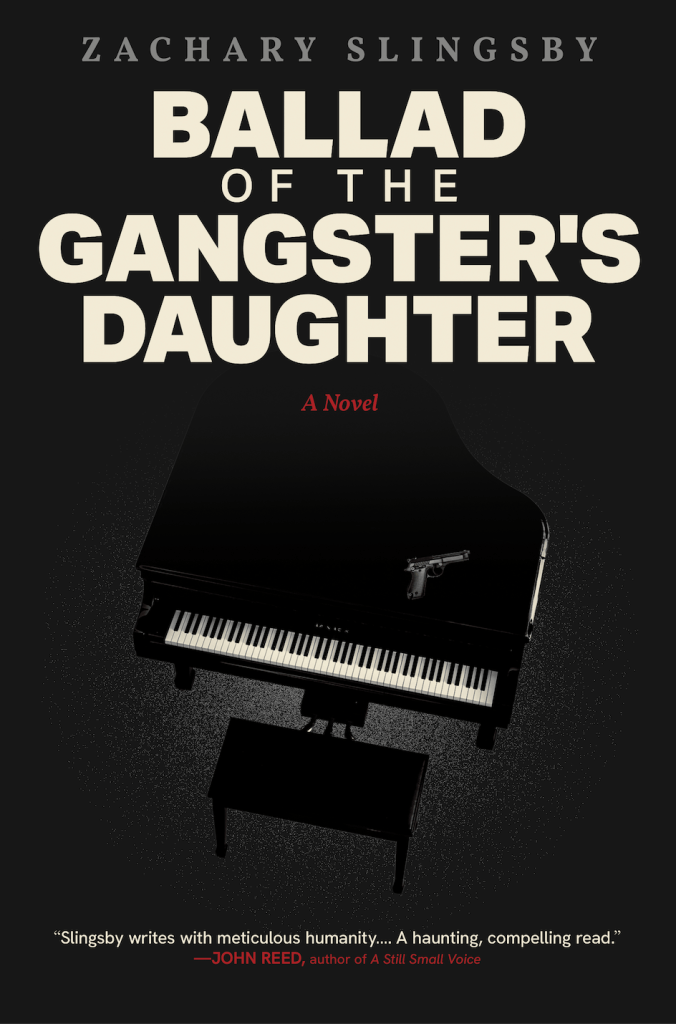
Ballad of the Gangster’s Daughter by Zachary Slingsby
Rating: ⭐⭐⭐⭐⭐
Zachary Slingsby’s Ballad of the Gangster’s Daughter is the kind of family saga that makes you realize fairly quickly that the word gangster in the title is only part of the story. At its center is Serena Magic, one of Gerard and Catherine Magic’s daughters, growing up first with memories of the Bronx and then in the family’s sprawling Connecticut home. From childhood, Serena knows that men arrive at night to conduct “business” with her father behind closed doors, but she doesn’t fully understand the world she is observing. In fact, one of the things I found both funny and revealing about young Serena is the elaborate explanation she creates for her father’s mysterious activities. She is perceptive enough to know something unusual is happening but still innocent enough to interpret the pieces through a child’s understanding of powerful men, secrets, and America. That gap between what Serena believes about her family and what readers gradually understand becomes one of the novel’s most interesting tensions.
“Zachary Slingsby turns the story of a gangster’s daughter into something much larger—a sweeping portrait of family, loyalty, ambition, grief, and the stories we tell ourselves about the people we love.”
What really drew me into the book was Serena herself. Slingsby could have written her simply as the sheltered daughter who discovers her father is not the man she thought he was, but she is much more complicated than that. She is observant, emotional, intelligent, stubborn, creative, and capable of making choices that do not always fit neatly into categories of right and wrong. Music is a part of her development from the beginning. Serena grows up listening to records, learns piano from her mother, and begins writing songs in a private notebook. There is something especially fitting about songwriting becoming part of her identity because Serena spends so much of the novel trying to make sense of feelings and experiences that ordinary conversation cannot quite contain. Her family history and her creative life aren’t separate threads.
The Magic family is also a huge reason to care about this novel. Gerard is particularly fascinating because Slingsby refuses to make him easy. He is a father whose daughters love him, a businessman, a man surrounded by secrecy, and someone whose ideas about strength, loyalty, protection, and family shape nearly everyone around him. Uncle Jimmy has his own personality and role within that world, and Serena’s sisters are not interchangeable background characters. Slingsby gives the Magic women different temperaments, loyalties, wounds, and ways of dealing with the family they were born into. I loved the observation that the sisters inherited Gerard’s candor and Catherine’s morbidity, creating women who have very little patience for one another’s self-deception. The book actually says, wonderfully, that “Not one of the Magic girls was harmless.” That tells you quite a bit about the family without telling you what happens to them.
There is also a tremendous amount of loss hanging over the Magic family, and I think that is essential to understanding Serena. The loss of Catherine and one of Serena’s sisters early in her life is only the beginning of a pattern that unfolds across decades. Importantly, Slingsby does not remove the Magic sisters from Serena’s life all at once. We get to know them as adults, watch their relationships with Serena change, and see them develop lives and struggles of their own before later tragedies gradually make the family smaller. Each loss arrives at a different stage of her life, forcing her to reconsider family, loyalty, grief, and the choices she has made. By allowing these deaths to stretch across decades rather than concentrating them into one period, Slingsby makes Serena’s experience of grief feel less like a single tragedy she survives and more like something that repeatedly reshapes her understanding of what it means to be a Magic.
That complexity feeds directly into what I think is one of the novel’s strongest themes: what happens when loving someone and believing they are good stop being the same thing? Serena’s relationship with her father keeps bringing her back to that uncomfortable territory. As the daughters grow older, Gerard gradually allows them to understand more about who he really is and, eventually, to come closer to his business world. One of Slingsby’s most perceptive observations comes when the novel considers what happens when a father violates a daughter’s ideas of goodness: she can surrender her ideas or surrender her love. Serena is not a character who finds either choice particularly simple. That is where the gangster element becomes more psychologically interesting than a conventional organized-crime story.
“The real power of Ballad of the Gangster’s Daughter lies not in asking whether the Magic family is good or bad, but in asking what happens when love refuses to fit inside such simple categories.”
I was also interested in Serena’s relationship with Brighton Salk because it grows naturally out of the larger family story rather than feeling added simply to give Serena a romance. Brighton has known Gerard’s world since childhood and essentially grows up inside the Magic orbit. His background helps explain both his toughness and his fierce sense of loyalty, while Serena’s feelings toward him develop against everything she knows—and doesn’t want to know—about the kind of life her father has built. Their personalities play well against one another. Brighton can be quiet, intimidating, and intensely practical; Serena talks, challenges, analyzes, jokes, and pushes. There is humor between them, but also an important question underneath their relationship: how much of the person we become is determined by the world that raised us? What makes their relationship convincing is that Slingsby lets us see the history beneath it rather than presenting it as instant attraction.
The themes of family loyalty, grief, morality, identity, class, violence, ambition, mortality, and legacy all work together particularly well. There is also an interesting contrast between the Bronx and Connecticut running beneath the story. The family gains material comfort and status after leaving the Bronx, yet Slingsby repeatedly questions whether having more actually makes them happier. At one point, the distinction is captured beautifully: the Bronx is associated with who you were, while Southport is associated with what you had. The Magic daughters look backward toward their smaller Bronx life with nostalgia because it represents a period when morality seemed uncomplicated—when they had chores and heroes rather than choices whose consequences they had to understand. The repeated presence of death makes that nostalgia even more poignant. The past isn’t merely somewhere Serena used to live; it becomes a place populated by people she can no longer return to. Adulthood therefore forces her to decide not only what parts of her inheritance she will accept or reject, but how she will carry the people who made her who she is.
The pacing is probably best described as expansive rather than fast. This is not a gangster thriller that races from crime to crime. Slingsby is interested in decades, relationships, conversations, family history, music, cultural changes, grief, and the accumulation of consequences. The novel’s seven-part structure allows Serena and the people surrounding her to age, change, lose things, build things, and reinterpret earlier experiences. There are stretches where the narrative slows considerably for character development or reflection, and readers looking strictly for a crime thriller may find those passages more deliberate than expected. I thought they generally worked because this is ultimately Serena’s life story and a family saga, not simply a criminal plot. When violence, death, or danger does intrude, it carries more weight because we already understand these people as a family. The transitions across time also reinforce one of the book’s larger ideas: consequences don’t always arrive immediately. Something said, hidden, believed, or done years earlier can continue echoing through a family long afterward.
Slingsby’s writing style is one of the more distinctive things about the novel. His prose can be funny, lyrical, observant, and unexpectedly philosophical, sometimes within the same scene. The narration frequently steps beyond immediate action to comment on memory, family, time, death, morality, or the strange ways people explain themselves to themselves. There is a strong sense of period throughout the book as well, with music and cultural references helping anchor Serena’s life within the decades she moves through. I especially liked the way music functions as more than atmosphere. Serena’s songwriting becomes another way of examining truth, which is particularly interesting for a woman raised in a family where truth can be concealed, reshaped, justified, or protected in the name of loyalty. That connection between songs, stories, memory, and the versions of ourselves we choose to believe feels central to what Slingsby is doing.
Overall, Ballad of the Gangster’s Daughter surprised me because I expected the criminal world to be the main attraction, and I came away much more interested in Serena Magic and the complicated emotional inheritance of being Gerard Magic’s daughter. Readers who enjoy multigenerational crime sagas with morally complicated families may find some of the same appeal here that they do in Don Winslow’s City on Fire, particularly in the combination of organized crime, family loyalty, identity, violence, and the long consequences of choices made in the name of people we love.

