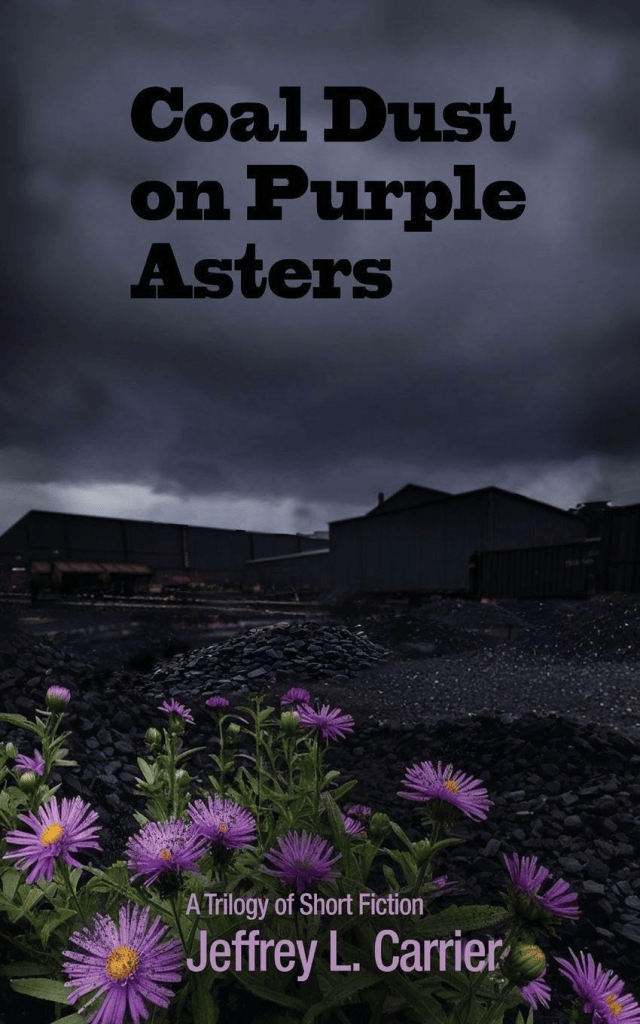
Coal Dust on Purple Asters by Jeffrey L. Carrier
Rating: ⭐⭐⭐⭐⭐
Coal Dust on Purple Asters by Jeffrey L. Carrier is a collection of three interconnected works of historical fiction set primarily in the coal country of Eastern Kentucky. Through Rain on Chinquapin Holler, A Sprig of Purple Asters, and Red Snow in the Kentucky Woods, Carrier brings readers into an Appalachian community where poverty, dangerous coal mines, natural disasters, family secrets, faith, and loss are all a part of everyday life. What I enjoyed most about this collection is how completely Carrier establishes a sense of place. Burfield County may be fictional, but by the time I finished reading, its hollers, muddy creeks, mountains, mines, little churches, and struggling families felt like somewhere I had actually visited.
Carrier tells us in the introduction that these stories grew from memories of his own family and the stories his grandmother told him about life in Kentucky. That connection comes through in the writing. There is an intimacy to the details that makes the stories feel passed down rather than simply invented. He remembers hearing about coal-dust poverty and relatives who survived hunger, heartbreak, floods, and the dangers beneath the mountains. He even incorporates the Appalachian English he remembers hearing from his grandmother.
That dialect is one of the first things that stood out to me. Carrier allows his characters to speak in the language of their community rather than smoothing their voices into standard English. It takes a little time to settle into the rhythm, but once I did, I could almost hear the characters speaking. It contributes greatly to the atmosphere and gives the collection the quality of an old family story being told on a porch.
The first story, “Rain on Chinquapin Holler,” introduces Vergie Hicks, a mother of two young girls whose marriage to coal miner Wiley Hicks is falling apart. Wiley drinks, disappears for days at a time, becomes abusive, and has begun an affair with Harriet Tolliver. Vergie finally decides she must take Ruthie and Meliss and leave him. What begins as a painful domestic story then changes dramatically when a terrible storm brings a flash flood into Chinquapin Holler.
I particularly liked how Carrier uses nature almost as another character. Early in the story, Vergie watches a robin building a nest and thinks about her own home coming apart. Later, the congregation prays for rain during a drought, with the preacher even invoking the biblical flood as he condemns the sins taking place in the community. The rain does come—but with terrifying force.
Wiley is also more complicated than I initially expected. Carrier never excuses his adultery, drinking, or abuse, but neither does he leave him as a one-dimensional villain. When Wiley learns Chinquapin has flooded, his immediate concern is Vergie and his daughters. On the dangerous journey home, he even stops to rescue another woman’s child before continuing toward his own family.
His final actions make the story especially bittersweet. Wiley reaches his family and saves his daughters and Vergie, but he is killed when their collapsing house is swept away. Later, Vergie and Harriet—the wife and mistress who might ordinarily have been written simply as enemies—end up grieving the same complicated man together. I thought that was an interesting choice. Wiley cannot undo the pain he caused, yet his final sacrifice proves that somewhere beneath everything that went wrong, his love for his family remained.
The second story, “A Sprig of Purple Asters,” moves forward to 1934 and the Great Depression. May and Zeke Owens are struggling to feed their children as coal mines close and employment disappears. Zeke is a World War I veteran who returned from France with a Purple Heart and a damaged leg, yet even his sacrifice for his country cannot protect his family from poverty. Carrier establishes their circumstances through small details—an empty flour sack, dwindling meat, children needing food, and men waiting outside a mine hoping someone will give them a day’s work.
One of the simplest moments in the collection was also one of my favorites. After finally earning a little money, Zeke returns home with cornmeal and several purple asters for May. They have almost nothing, but he still thinks to bring his wife flowers. Against the hunger and uncertainty surrounding them, those slightly wilted flowers become something surprisingly powerful. They represent tenderness surviving where almost everything else has been stripped away.
“Carrier finds beauty in people who have very little, reminding us that hope can sometimes be as simple as a handful of cornmeal, a few wildflowers, and the determination to begin again.”
This story also becomes darker as May’s troubled brothers, Lincoln and Millard Tompkins, enter the family’s already precarious life. Carrier uses their arrival to examine another side of poverty: what desperation can bring out in people. May is caught between the Appalachian expectation that family should care for family and the reality that feeding two additional grown men could mean taking food from her own children.
Again, the title imagery becomes important. By the end, after another devastating loss, Zeke tells May that they still have one another and can rebuild. Then he produces another bundle of asters. The repetition could have felt sentimental, but for me it worked because the flowers have acquired a different meaning. They are no longer simply a romantic gesture. They represent endurance.
The third story, “Red Snow in the Kentucky Woods,” was perhaps the most fascinating to me because Carrier shifts the structure. The story opens decades later with seventy-year-old Cory returning from California to Kentucky for his mother’s funeral. His ten-year-old grandson Casey notices an unusual gravestone bearing two names, and Cory begins telling him the story behind it.
From there, the collection becomes part family mystery. Cory investigates the disappearance of James Herald and begins following pieces of information that have survived across forty years. An old adventure book, memories from elderly residents, abandoned Black Spring, railroad tracks, newspaper archives, and the possibility of an unidentified boy found near a depot gradually become clues. I enjoyed this change because it gives the final story a mystery element while maintaining the themes established in the first two.
The abandoned mining town is particularly effective. By this point, readers understand what coal once meant to Burfield County. Mines didn’t simply provide employment; entire communities existed because of them. When Cory encounters what remains of Black Spring, the deteriorating town becomes a reminder that places can disappear almost as completely as people do. Yet memories survive through the people willing to preserve them.
That idea connects all three stories.
“Coal Dust on Purple Asters feels like opening an old family trunk and discovering that beneath the dust are stories of people whose lives were difficult, imperfect, tragic, and still worth remembering.”
Carrier’s descriptive writing is one of the collection’s greatest strengths. He has an eye for sensory details: oil lamps glowing inside small houses, coal dust clinging to miners’ bodies, muddy floodwater, autumn leaves, woodsmoke, mountain fog, cornbread and honey, wildflowers, and snow covering forgotten graves. Beauty and hardship frequently occupy the same scene.
For readers who enjoy modern Appalachian fiction, this collection reminded me somewhat of The Book Woman of Troublesome Creek by Kim Michele Richardson. The premises are different, but both bring readers into historical Eastern Kentucky and use strong regional atmosphere, poverty, community, and resilience to bring Appalachian lives to the foreground. However, Carrier’s work is more intimate and family-story driven.
Overall, Coal Dust on Purple Asters is a moving collection about people who endure circumstances that continually threaten to break them. Jeffrey L. Carrier doesn’t romanticize poverty, dangerous mining work, domestic violence, hunger, or grief, but neither does he allow those hardships to completely define his characters. There is love here, humor, faith, regret, sacrifice, family loyalty, and the stubborn determination to rebuild after everything familiar has been washed away, burned, buried, or lost. This book is for readers who enjoy historical fiction, Appalachian literature, multigenerational family stories, and rural American history.

